
The Question Begins With a Boat
Chy Lung v. Freeman (1875) · Chae Chan Ping v. United States (1889) · Fong Yue Ting v. United States (1893)
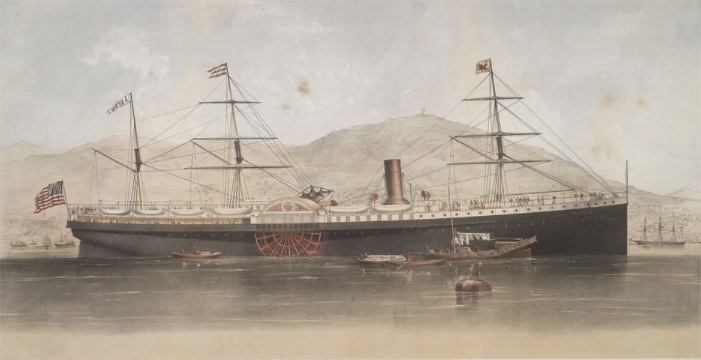
On August 24, 1874, the steamship Japan arrived in San Francisco Bay after more than a month at sea, carrying tea, returning locals, and several hundred Chinese immigrants.1 Among them were twenty-two women traveling without husbands or children. California's Commissioner of Immigration, Rudolph Piotrowski, a Polish immigrant himself, boarded the ship with an interpreter and questioned the women about their marital status and family in the United States.2 Under a California statute amended that same year, an inspector's judgment that a woman was "lewd or debauched" was enough on its own. Piotrowski found their answers unsatisfactory and classified twenty-two of them accordingly.3 The captain would have to post a $500 bond for each woman or take them back to China.
The captain refused to pay. The women stayed locked aboard the Japan, anchored in the harbor, while San Francisco argued about what to do with them.
This is where the question starts. Not "does America belong to Asian Americans on equal terms," exactly, not yet, but a narrower and more practical version of it: who gets to decide that question in the first place? A state commissioner standing on a dock? A captain with a ship to unload? Congress, three thousand miles away? The Supreme Court would spend the next two decades answering that procedural question over and over, in three cases that look, on the surface, like a single steady win for federal authority. Underneath, they tell a more complicated story about what a win is actually worth, and to whom.
A Bond, a Commission, and Twenty-Two Women
Piotrowski's job existed because of an 1870 California statute, amended in 1874, that let the state screen incoming passengers for a list of undesirable categories: convicts, the "lunatic," the "infirm," and, separately, any woman an inspector judged to be "lewd or debauched." If a ship's master couldn't satisfy the commissioner that a passenger fell outside those categories, he had two choices: post a $500 gold bond per passenger, or sail them back where they came from.
The law had a second feature, less visible at the time but more revealing in retrospect. The statute let the commissioner charge a fee for preparing each bond and administering the required oaths, and entitled him to retain twenty percent of any "commutation money," cash paid in place of a bond, before depositing the rest with the state treasury.4 That structure created an obvious financial incentive to find more passengers unfit, whatever Piotrowski's actual motives were in any individual case. Justice Miller would later call the arrangement, in the Court's own words, an invitation to "systematic extortion of the grossest kind."5
San Francisco's press did not wait for a court to weigh in. Within two days of the Japan's arrival, the Daily Alta California was already calling it "A Furore in Chinadom." Over the following weeks, the same women appear in print as "Chinese Maidens" with "undeniable evidence of their immoral tendencies," then as "Chinese Courtesans," then, by September 13, as "The Celestial Maidens." By the time Justice Stephen Field heard the case on circuit, the San Francisco Chronicle was calling them "Cyprians," a Victorian euphemism for prostitutes drawn from the mythology around Aphrodite's island.6 Twenty-two women who had not been convicted of anything, examined by no one but a state official with a financial stake in the outcome, got escalating headlines for a month before any court decided whether the law that detained them was even valid.
Most of them didn't wait to find out. Habeas corpus petitions worked their way through state and federal court, and Justice Field, riding circuit, ordered the bulk of the women released before the case reached the U.S. Supreme Court.7One woman's case proceeded anyway: Chy Lung, whose name now sits on the front of the opinion, pressed the constitutional question forward after the others had already won their freedom and presumably wanted nothing more to do with the California courts. Almost nothing else about her survives in the historical record. Not where she went afterward. Not what she made of a case that still carries her name a century and a half later. The silence is its own kind of evidence about who got remembered and who didn't, and about how often that choice had nothing to do with what someone actually deserved.
Chy Lung v. Freeman reached the Supreme Court, and the Court ruled for her unanimously in 1875.8 But it's worth being precise about what, exactly, the Court found objectionable. Justice Samuel Miller's opinion barely engages with whether the women had done anything wrong, or whether a 20-percent commission baked into a "morality" statute might itself be the scandal. The opinion is about jurisdiction. California, the Court held, had no business setting immigration policy at all; that power belongs to the federal government, full stop, because immigration touches foreign relations and foreign relations cannot be conducted state by state.9 It is a sound, even an important, constitutional principle. It is also, notably, not a ruling that what happened to these twenty-two women was wrong. It is a ruling that California wasn't the one with the authority to do it.
That distinction would not stay abstract for long.
A Federalism Problem, Quickly Solved the Wrong Way
If Chy Lung established that only the federal government could police Chinese immigration, the obvious question is what the federal government then chose to do with that power. The same year the decision came down, Congress passed the Page Act of 1875.10 The two were not directly connected. The Page Act had already been moving through Congress before the Court ruled, driven by the same anti-Chinese sentiment in California and ongoing tension over the Burlingame Treaty, not as a response to Chy Lung specifically. But the coincidence is instructive regardless of causation: the federal government landed on almost the identical judgment California had just lost the authority to make. Written narrowly, the Page Act targeted contract laborers and women suspected of entering for "immoral purposes," largely meaning prostitution. Enforced broadly, it became one of the primary mechanisms by which immigration officials excluded Chinese women generally, since proving a negative, that a given woman was not coming for prohibited purposes, fell to her and her alone.11 The mechanism had changed, and the body exercising it had changed. For most Chinese women trying to immigrate, the outcome very often didn't.
The practical effect was severe and lasting. The Page Act is widely credited as a major contributor to the heavily male-skewed demographics of Chinese American communities that persisted for decades afterward, though it operated alongside other restrictions, including the Chinese Exclusion Act seven years later, that compounded the same effect.12Chy Lung won the battle over who got to ask the question. It did comparatively little to change the answer.
Twelve Years, a Certificate, and a Word That Outranked It
Fourteen years after the Japan sat in San Francisco Bay, a Chinese laborer named Chae Chan Ping did everything the system asked of him. He had lived and worked in San Francisco since 1875, the same year Chy Lung was decided, for more than a decade.13 In 1887, he wanted to visit China. Before he left, he secured a certificate of re-entry from the San Francisco customs collector, exactly as the Chinese Exclusion Act of 1882 required. The certificate existed precisely so that laborers like him could travel and come home. He sailed for Hong Kong in September 1888 aboard the steamship Belgic, his return voyage already arranged, his paperwork already in order.
While he was at sea, Congress passed the Scott Act, which voided every outstanding re-entry certificate and barred Chinese laborers from returning at all, regardless of what the government had previously promised them in writing.14Chae Chan Ping had no way to know this had happened. He arrived in San Francisco on October 8, 1888, certificate in hand, and was told the document was worthless. He was detained aboard the ship that brought him.
His case made it to the Supreme Court with serious legal firepower behind it. Chinese benevolent associations, the same kind of mutual-aid organizations that would later fund Yick Wo's defense, retained a team of prominent attorneys, including a former governor of Ohio, to argue that the certificate was a binding promise the government couldn't simply erase, and that revoking it amounted to taking his property and liberty without due process.15
The Court disagreed, unanimously, and the language Justice Stephen Field used to explain why is worth sitting with rather than summarizing. The opinion quotes at length an 1878 memorial from California's constitutional convention describing Chinese immigration as an "Oriental invasion" that was "a menace to our civilization."16 How much of that framing Field personally endorsed, as opposed to incorporated as evidence of the prevailing view he believed Congress was entitled to act on, is something historians still debate. What isn't in dispute is what he built on it: the power to exclude foreigners, he wrote, is an inherent feature of national sovereignty, and if the government believes "the presence of foreigners of a different race in this country, who will not assimilate with us" threatens the country's peace and security, the courts have no business second-guessing that judgment.17 Field was explicit that this held even where prior treaty commitments suggested otherwise. The Burlingame Treaty and its 1880 supplement had promised Chinese laborers the right to travel freely; Field held that Congress could simply legislate past a treaty whenever it chose to, since a treaty carries no greater weight than an ordinary statute passed afterward.18
What the case actually decided, stripped of its rhetoric, was narrower and more durable than the language suggests: that Congress's power over immigration is close to absolute, and that a certificate issued by the government today creates no enforceable right against the government changing its mind tomorrow. Scholars now call it one of the principal foundations of what's known as the "plenary power doctrine," a label that has stuck for good reason, alongside companion cases decided in the years just after.19 It is still cited. It is still the law.
The Same Power, Turned on People Already Home
If Chae Chan Ping answered who could be kept out, Fong Yue Ting answered something colder: whether the same unreviewable power could reach people who were already, by any ordinary use of the word, home.
The 1892 Geary Act required every Chinese laborer in the United States, regardless of how long they'd lived there, to carry a certificate of residence or face arrest and deportation.20 Proving eligibility for that certificate required a witness, and the statute specified what kind: at least one "credible white witness." A Chinese laborer's word, or another Chinese resident's testimony, did not count.21 Fong Yue Ting had lived in the United States since before 1879. He hadn't gotten a certificate by the deadline. Two other men, Wong Quan and Lee Joe, were arrested alongside him; Lee Joe had actually tried to register, and was turned down precisely because the witnesses he produced were, like him, Chinese.22
Resistance to the law was organized and nearly total. The Chinese Six Companies urged the community not to register at all, and to fund a legal challenge instead, and the community listened: of an estimated 110,000 Chinese residents subject to the Geary Act, only 3,169 had registered by the original deadline.23 That is not a footnote. That is most of a community choosing collective legal defiance over individual compliance with a requirement many contemporaries viewed as making compliance extraordinarily difficult by design.
The Supreme Court upheld the Geary Act, 5 to 3, building directly on Chae Chan Ping.24 Justice Horace Gray's majority opinion treated deportation as simply the back half of the same power the Court had already blessed in 1889: if the government can keep someone out, the logic ran, it can just as easily put someone out, regardless of how long they've been here or how thoroughly they've built a life on the assumption that they could stay.
Three justices dissented, and one of them is worth naming specifically because his words cut through the case's abstractions in a way the majority's didn't. Justice David Brewer wrote that the men in front of the Court were "lawfully residing in this country," and that deportation, dressed up as administrative procedure, was in plain fact a punishment, "and that oftentimes most severe and cruel."25 He was outvoted. The "credible white witness" requirement, the demand that Chinese testimony about Chinese lives be treated as inherently unreliable, stood as federal law.
There is a strange, instructive footnote here too. Justice Field, who wrote Chae Chan Ping and built the very doctrine Fong Yue Ting now relied on, dissented in this case.26 He drew a distinction the majority refused to recognize: a government might have broad power to decide who comes in, he reasoned, but someone who has already built a home, a residence, a life inside the country has a claim the law owes more respect than that. The author of the doctrine thought the doctrine had limits. The Court he sat on disagreed, and his own reasoning from four years earlier is exactly what got cited against him.
What a Win Is Worth, and When?
Read together, these three cases resist the easy story where the Supreme Court starts out hostile and gradually learns better, or where one Asian American win in 1875 sets a precedent that reliably protects the next person down the line. Chy Lung won, and it did leave behind a real constitutional boundary, federal exclusivity over immigration, that still matters and still gets cited today. But the Page Act arrived the same year and reached most of the same result through a different door. Chae Chan Ping lost, and the loss became one of the most durable doctrines in American constitutional law, invoked for over a century since, sometimes to exclude people based on openly stated animus, sometimes cited by lower courts trying to slow down exactly that kind of exclusion. Fong Yue Ting lost worse, turning the same unreviewable power against people who had never left the country at all, over a witness requirement that made Chinese testimony about Chinese lives count for nothing under federal law.
The throughline isn't simple progress. It's leverage, and how unevenly it gets distributed depending on who holds it at a given moment. A legal "win" in one of these cases bought real, immediate relief for the specific person involved, but it didn't reliably outlast the political moment that produced it. The Page Act showed how quickly a court ruling can be functionally sidestepped by ordinary legislation aimed at the same target. The plenary power doctrine showed something different and in some ways more durable: a ruling can outlive its original target entirely and get redeployed, generation after generation, against whichever group the political branches currently want to exclude. In 2017, federal appellate judges on the Fourth and Ninth Circuits discussed the limits of plenary power, including the doctrinal line running back through Chae Chan Ping, while weighing challenges to an early version of a presidential travel ban.27The following year, the Supreme Court relied on that same doctrinal lineage to uphold a later version of the ban.28 The same 1889 case has anchored arguments on both sides of essentially the same dispute, not because the doctrine is unstable, but because it was built primarily to preserve governmental discretion rather than to protect anyone's rights, which means it bends toward whoever is currently exercising that discretion.
That is, maybe, the most uncomfortable lesson sitting underneath all three cases, and here the analysis turns into an argument rather than a strict accounting of what each court held. A rule that depends on who currently holds power isn't, in the end, a very reliable rule. It's a temporary advantage, available to be flipped the moment the people in charge change. The version of fairness worth wanting is the kind that holds up regardless of who's asking it to bend, the kind that doesn't depend on whether the people affected are a community you sympathize with or one you don't. By that measure, Chy Lung came closer than the other two to establishing something durable, and watched much of its practical force undercut within the year anyway. Chae Chan Ping and Fong Yue Ting built a doctrine sturdy enough that it's still doing recognizable work, for different groups entirely, a century and a half later.
Not everyone whose name sits on one of these cases wanted to be a symbol of any of this. Chy Lung pursued her case after the women detained alongside her had already won their freedom and could simply have gone on with their lives; whatever she thought she was fighting for, almost none of it survives in writing. Chae Chan Ping and Fong Yue Ting left behind court records and almost nothing else: no memoir, no interview, no account in their own words of what it felt like to do everything correctly and lose anyway. That absence reflects a broader pattern in this period's historical record, where ordinary litigants without wealth, education in English, or access to the press often left behind only the paperwork a court case generated, and nothing more. Some plaintiffs become public figures. Most just wanted to go home, or stay home, and the law decided otherwise.
Related Cases and Precedents
The Page Act of 1875 — Federal legislation enacted the same year as Chy Lung, which reached, by a different legal route, much of the same exclusion of Chinese women that California had just lost the authority to enforce directly.
Nishimura Ekiu v. United States (1892) — Decided between Chae Chan Ping and Fong Yue Ting, this case extended the same judicial deference to exclusion decisions made by immigration officers, reinforcing that courts would not second-guess the executive branch's immigration judgments.
The Geary Act of 1892 — The statute at issue in Fong Yue Ting, requiring certificates of residence backed by a "credible white witness."
Korematsu v. United States (1944) — Decades later, a similar logic of near-total deference to the political branches on questions of national security and "who belongs" would be extended from immigration law into the wartime incarceration of Japanese American citizens, including people who had never been immigrants at all.
Trump v. Hawaii (2018) — The Supreme Court relied on the plenary power doctrine traceable to Chae Chan Ping to uphold a presidential travel ban targeting several majority-Muslim countries, even as the doctrine's limits had been debated by lower courts considering an earlier version of the same ban.
Sources and Further Reading
For deeper reading:
Lucy E. Salyer, Laws Harsh As Tigers: Chinese Immigrants and the Shaping of Modern Immigration Law (UNC Press, 2d ed. 1995)
Rose Cuison Villazor, "Chae Chan Ping v. United States: Immigration as Property," 68 Oklahoma Law Review137 (2015)
AABANY's trial reenactment, 22 Lewd Chinese Women, performed and narrated in part by Judge Denny Chin, dramatizes the events behind Chy Lung v. Freeman. A separate body of original archival research on this case also exists and may be linked here in a future update.
Kathleen Kim, Kevin Lapp & Jennifer J. Lee, eds., Feminist Judgments: Rewritten Immigration Law Opinions(Cambridge University Press, forthcoming), including a rewritten Chy Lung opinion
Footnotes
Federal Judicial Center, "Chinese Immigration Restriction,"Justice for All: Courts and the Community. ↩
Gabriel Chin, Anna Hsia & Rose Cuison Villazor, "Commentary on Chy Lung v. Freeman," draft manuscript for Feminist Judgments: Rewritten Immigration Law Opinions (Cambridge University Press), citing Transcript of Record, Chy Lung v. Freeman, 92 U.S. 275 (1875). ↩
AABANY Reenactments, "22 Lewd Chinese Women: Chy Lung v. Freeman," trial reenactment script, drawing on the original trial transcript. ↩
Chy Lung v. Freeman, 92 U.S. 275 (1875), opinion text via Cornell Legal Information Institute. ↩
Paul A. Kramer, "The Case of the 22 Lewd Chinese Women,"Slate, April 23, 2012, quoting Justice Miller's opinion. ↩
AABANY Reenactments, "22 Lewd Chinese Women: Additional Resources," compiling original Daily Alta California and San Francisco Chronicle headlines, August–September 1874. ↩
Chy Lung v. Freeman, Wikipedia, summarizing Justice Field's circuit release order; see also Federal Judicial Center, supra note 1. ↩
Chy Lung v. Freeman, 92 U.S. 275 (1875). ↩
Id.↩
Foundations of Law and Society, "Chy Lung v. Freeman: A Tale of Chinese Immigration," noting the Page Act's passage the same year as the decision. ↩
Geary Act, Wikipedia, summarizing the Page Act's statutory targets and practical enforcement against Chinese women generally. ↩
Id.↩
Chae Chan Ping v. United States, 130 U.S. 581 (1889), statement of facts via Justia. ↩
Chae Chan Ping v. United States, Wikipedia, summarizing the Scott Act's effect on outstanding certificates. ↩
Id., summarizing counsel and legal arguments. ↩
Chae Chan Ping v. United States, 130 U.S. 581, 595 (1889), opinion text via Cornell Legal Information Institute, quoting the 1878 California constitutional convention memorial. ↩
Id. at 606. ↩
Id.; see also Fordham Law News, "Rewriting Chae Chan Ping," summarizing Professor Rose Cuison Villazor's analysis of the case's treaty-override holding. ↩
David A. Martin, "Why Immigration's Plenary Power Doctrine Endures," 68 Oklahoma Law Review (2015). ↩
Fong Yue Ting v. United States, 149 U.S. 698 (1893), opinion text via Cornell Legal Information Institute. ↩
Id., statement of facts; see also Quimbee, "Fong Yue Ting v. United States Case Brief."↩
Fong Yue Ting v. United States, 149 U.S. 698 (1893). ↩
Id. (Brewer, J., dissenting). ↩
Id. (Field, J., dissenting); see also Fong Yue Ting v. United States, Wikipedia, summarizing the dissent's distinction between exclusion and deportation. ↩
Just Security, "The Radical Supreme Court Travel Ban Opinion," discussing plenary power doctrine's role in early travel ban litigation; Chae Chan Ping v. United States, Wikipedia, summarizing citations to the case in Trump v. Hawaii–era litigation. ↩
Trump v. Hawaii, 585 U.S. 667 (2018); see also Margo Schlanger, "Symposium: Could This Be the End of Plenary Power?," SCOTUSblog, July 2017. ↩