
CLE-Ready: Everything Your Bar Association or Firm Needs to Approve and Promote This Program
Simon Tam's presentations come with the materials your CLE accreditation process requires:
pre-written, ready to submit.
Learning Objectives
Upon completion of this program, attendees will be able to:
Trace the legislative history and application of Section 2(a) of the Lanham Act, including the origins of the disparagement clause and the circumstances that brought it before the courts in Matal v. Tam.
Identify best practices for client relationship management in high-profile and high-stakes litigation, drawing on the unique dynamics of a case that drew national media attention over an eight-year period.
Examine the disparate impacts of facially neutral policies, using the disparagement clause as a case study in how administrative standards can affect marginalized communities differently than intended.
Apply perspective-taking and negotiation techniques relevant to working with pro bono and cause-driven clients, including managing expectations and aligning legal strategy with client values.
Analyze the strategic decision to pivot from technical and administrative arguments to constitutional grounds, and the implications of that shift for case framing and litigation strategy.
Timed Agenda
I. Introduction to personal history / experiences grappling with Asian American identity (10 minutes)
Personal narrative exploring identity formation, cultural perception, and early experiences with stereotyping and language. Establishes the lived context that later informs the dispute over trademark disparagement and expressive identity.
II. Starting The Slants, initial work in arts & activism (10 minutes)
Chronological account of forming the band as a vehicle for cultural expression and reappropriation of a historically derogatory term. Early artistic decisions as intentional expressive conduct later relevant to First Amendment analysis.
III. First trademark application and initial appeals process; background on Section 2(a) of the Lanham Act (10 minutes)
Overview of the first USPTO application and rejection under Section 2(a)’s disparagement clause. Administrative appeals process and early legal issues concerning evidentiary standards and interpretation of “disparagement” in trademark examination.
IV. Second application and evidentiary issues (10 minutes)
Second attempt to register the mark, including refinement of evidentiary submissions addressing the USPTO’s disparagement analysis. Focus on how intent, public perception, and linguistic evidence were evaluated in the administrative record.
V. Federal Circuit appeal and First Amendment considerations; sua sponte en banc review (5 minutes)
Appeal to the U.S. Court of Appeals for the Federal Circuit, including evolving First Amendment arguments regarding viewpoint discrimination in trademark registration. Discussion of the court’s sua sponte order vacating panel decision and directing en banc review.
VI. Supreme Court proceedings in Matal v. Tam, legal and ethical considerations (10 minutes)
Summary of arguments before the Supreme Court, including constitutional issues surrounding viewpoint discrimination, government vs. private speech, and trademark registration. Reflection on the ethical dimensions of advocacy and the personal experience of participating in landmark constitutional litigation.
VII. Aftermath of SCOTUS decision and key lessons for legal practice and public policy (final segment)
Post-decision impact on trademark law and USPTO practice, including the removal of the disparagement bar and its broader implications for expressive marks. Practical lessons for attorneys advising clients on branding, speech-related risk, and navigating government registration systems after Matal v. Tam.
OPTIONAL: Question and Answer session on Matal v. Tam, how the case has shaped subsequent First Amendment jurisprudence, including Iancu v. Brunetti, and applying the case's reasoning to emerging questions in First Amendment and IP law.
Substantive Written Materials
CLE Handout: Trademark Disparagement & First
Amendment (download .pdf here)
Selected Scholarship/Supplemental Reading:First Amendment, Trademarks, and "The Slants": Simon Tam, Buffalo Law Journal, 2018
A detailed written analysis — forthcoming in the Free Speech Journal — is available to accompany this presentation, exploring First Amendment development in depth.
Accreditation History
Simon has presented for CLE credit or as part of accredited legal programming at the following organizations. Programs generally approved as 60-minute CLE sessions, with optional Q&A depending on host rules. Specific credit approval varies by jurisdiction and program format.
National associations
American Bar Association, 2017–2019.
International Trademark Association (INTA), 2018.
International Federation of Intellectual Property Attorneys (FICPI), 2023.
International Association for the Protection of Intellectual Property (AIPPI), 2017–2018.
State bars
State Bar of Texas Annual Meeting, 2022.
State Bar of Wisconsin, 2019.
State Bar of Washington, 2019.
State Bar of Oregon, 2015–2019.
State Bar of North Carolina, 2018.
State Bar of New York, 2019.
State Bar of Tennessee, 2015–2018.
State Bar of Michigan, 2019.
Inns of Court and affiliated programs
Inn of Court / State Bar of Georgia, 2019.
Inn of Court / Minnesota State Bar Association Annual Conference, 2023.
Conferences and institutes
AT&T Legal Conference (Texas), 2022.
Midwest IP Institute, 2019.
CPIP Music Law, 2018.
Association of Defense Trial Attorneys, 2019.
American Constitution Society, 2016–2019.
Federalist Society, 2016–2019.
Biography (Short)
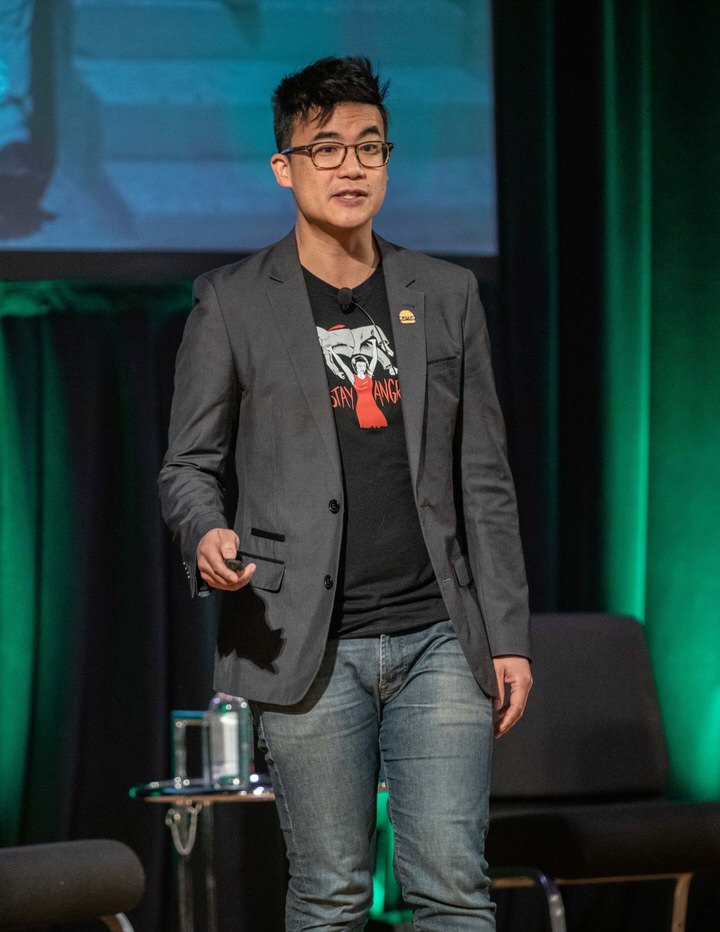
Simon Tam is an award-winning author, keynote speaker, and civil liberties advocate best known as the central figure in Matal v. Tam — a unanimous U.S. Supreme Court decision that redefined First Amendment protections in trademark law. He is the founder and bassist of The Slants, the world's first all-Asian American dance rock band, and the author of Slanted: How an Asian American Troublemaker Took on the Supreme Court. Simon's work has been featured in over 3,000 media outlets across 150 countries, including Rolling Stone, TIME, NPR, BBC, and the New York Times. He is also co-founder of The Slants Foundation.
Biography (Complete)
Simon Tam spent eight years fighting the United States government — and won. In 2017, the Supreme Court ruled unanimously in his favor in Matal v. Tam, a landmark First Amendment case that began with a simple question: who gets to decide what a community calls itself?
As the founder and bassist of The Slants, one of the first all-Asian American dance rock bands in the world, Simon turned a fight over a trademark application into a Supreme Court case that's now taught in classrooms across the country. He is the recipient of the Mark T. Banner Award from the American Bar Association and the Hugh M. Hefner First Amendment Award, and his case was named Milestone Case of the Year by Managing IP Magazine.
His memoir, Slanted: How an Asian American Troublemaker Took on the Supreme Court, was named one of the Best Books on the Constitution of All Time by BookAuthority and won the Independent Publisher Book Award for Best Autobiography/Memoir. Simon's story has been featured in thousands of media outlets across 150 countries, including The New York Times, The Washington Post, Rolling Stone, NPR, and The Daily Show with Trevor Noah.
He is also co-founder of The Slants Foundation, a nonprofit supporting civil liberties, the arts, and civic engagement — and his work is now part of the permanent collections at the First Amendment Museum, the National Constitution Center, the Wing Luke Museum, the Songbirds Museum, and the Rock and Roll Hall of Fame.
Technical Requirements
A collection of technical specifications and best practices for hosting Simon's presentation. Review the technical requirements →