
The Plaintiff Without a Name
Students for Fair Admissions v. Harvard / University of North Carolina (2023)
Every other case in this series has a name attached to it: a person who showed up at a port, a school, a curfew checkpoint, and became, whether they wanted to or not, the human being a Supreme Court case gets remembered by. Students for Fair Admissions v. Harvard breaks that pattern. The actual Asian American applicants whose rejections form the evidentiary core of the case remain anonymous in the public record to this day. The named plaintiff is an organization, not a person, and the organization was built, by its own founder's account, specifically because he calculated that Asian American plaintiffs would make his underlying legal argument land more persuasively than the white plaintiffs he'd previously recruited.
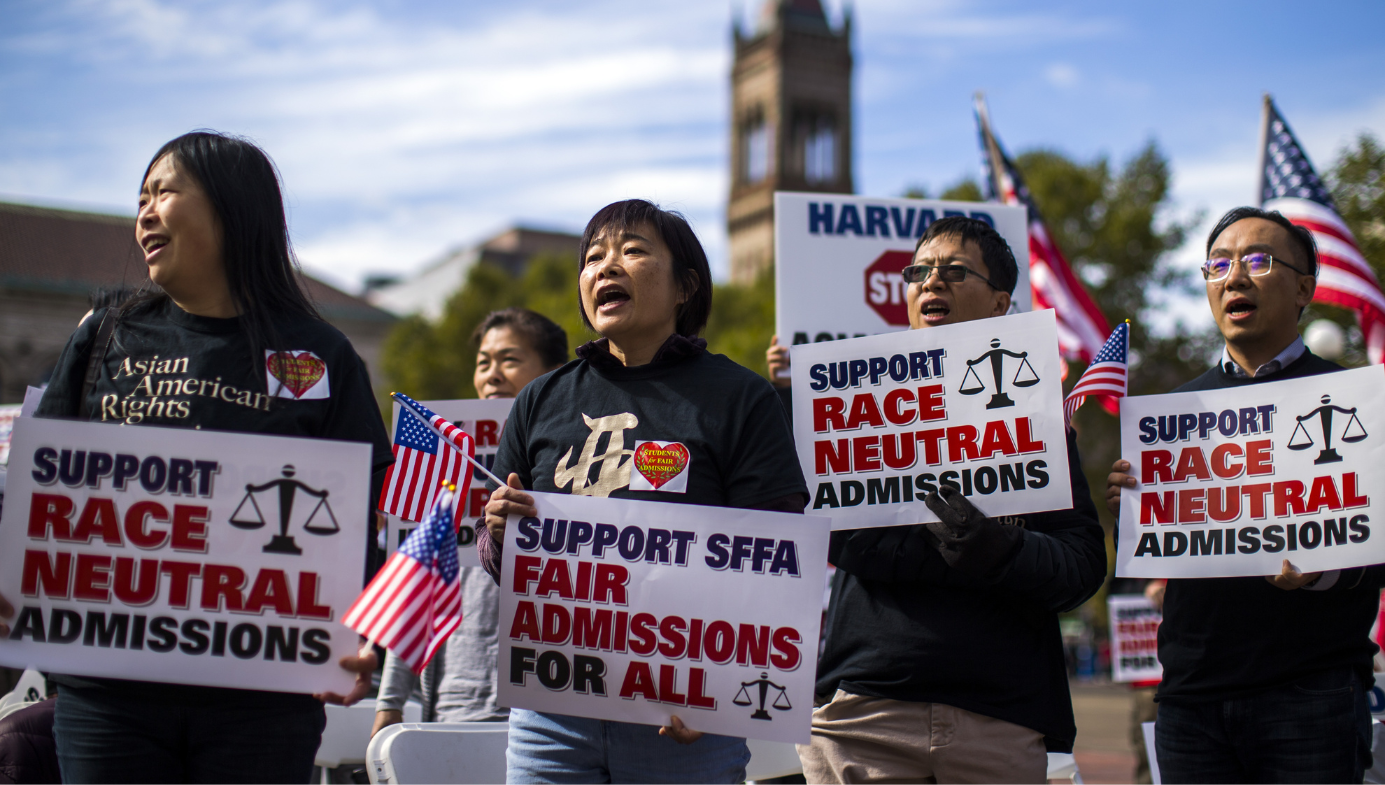
That's an unusual place to start a piece about a Supreme Court case in a series built around centering the people behind the law. But it's the honest place to start, because how this case came to exist, who built it, and why, matters as much to understanding what it actually decided as the opinion itself does.
A Decision Forty-Five Years in the Making
To understand what SFFA did, you have to understand what it undid, and that story starts decades earlier and with a plaintiff who wasn't Asian American at all. In 1978, Regents of the University of California v. Bakke reached the Supreme Court after Allan Bakke, a white applicant to UC Davis's medical school, was rejected twice despite test scores higher than some students admitted through a separate track the school had reserved specifically for minority applicants, sixteen seats out of one hundred, set aside before the rest of the pool was even considered.1 The Court split badly, six different opinions, no single rationale commanding a majority. Justice Lewis Powell's controlling opinion struck down that specific kind of rigid numerical set-aside while simultaneously holding that achieving educational diversity was a compelling enough interest to let a university consider race as one factor among many, in a more flexible, individualized process.2 Bakke himself was admitted under the Court's order, graduated, and spent his career as an anesthesiologist, his name forever attached to a framework he didn't ask for and didn't shape, decided by a Court too divided to agree on why he'd won.
Powell's improvised compromise held for forty-five years, reaffirmed in Grutter v. Bollinger in 2003, when the Court, again citing the educational benefits of diversity, projected that race-conscious admissions would no longer be necessary within roughly twenty-five years.3 SFFA arrived nineteen years after that projection, with a question Bakke's own case had never quite settled: what happens when the people diversity programs are said to disadvantage aren't the white applicants the framework was originally built to discuss, but a different minority group entirely, one this series has spent six pieces watching get sorted, excluded, and reclassified by exactly this kind of institutional discretion before?
The Man Who Needed Asian Plaintiffs
Students for Fair Admissions did not emerge from a community of Asian American families organizing around a shared grievance, the way the Chinese Six Companies organized behind Yick Wo, or the way Mrs. Lau's own worry about her son's classroom became Edward Steinman's case. It was built, deliberately and from the outside, by Edward Blum, a former stockbroker and self-described "amateur litigator" who has personally engineered eight Supreme Court cases since the 1990s, none of them his own grievance, all of them built around plaintiffs he found, recruited, and connected to conservative donor-funded legal teams.4 Blum's first attempt to challenge race-conscious admissions used a white plaintiff, Abigail Fisher, suing the University of Texas; the Supreme Court declined to give him the sweeping ruling he wanted.5 He drew a direct lesson from that loss and said so himself, telling a Houston Chinese American audience in 2015, in a sentence that has followed this case ever since: "I needed Asian plaintiffs."6 What Blum meant by this, by his own subsequent explanation, wasn't a claim about appearance; it was a calculation that an argument framed around discrimination against Asian American applicants would land more persuasively, both legally and politically, with a Court skeptical of "reverse discrimination" claims brought by white plaintiffs.
Founded in 2014 with a leadership structure consisting, at the outset, of Blum himself and the Fishers, Students for Fair Admissions built its case around recruited Asian American applicants who had been rejected by Harvard, organized as members of a nonprofit advocacy organization rather than as individually named plaintiffs suing in their own names.7This matters legally as much as symbolically. When Harvard and UNC challenged whether SFFA even had legal standing to bring the case at all, arguing it wasn't a genuine membership organization controlled by the people it claimed to represent, the Supreme Court sided with SFFA, holding that the universities hadn't shown enough to defeat associational standing for an organization with voluntary members who supported its mission and received updates on the litigation, even though those members didn't direct the case's strategy day to day.8 The case that would end affirmative action nationwide was, procedurally, brought by an organization on behalf of members whose identities remain largely unknown to the public.
None of this means the underlying statistical disparity Asian American applicants experienced wasn't real, and it would be a mistake to let Blum's strategy discredit the evidence entirely. Blum himself has consistently described his work in different terms than his critics do, framing it not as exploitation but as the enforcement of a colorblind reading of the Equal Protection Clause that he argues protects everyone equally, Asian American applicants included, regardless of who benefits in any particular case.9 Whichever framing one finds more persuasive, the underlying grievance, an Asian American advocacy organizations had separately raised with federal civil rights officials as early as 2015, got channeled into a lawsuit built, funded, and steered by people whose stated goal was never primarily about correcting harm to Asian American applicants specifically. It was about ending race-conscious admissions everywhere, for everyone, and Asian American plaintiffs were, in Blum's own telling, the plaintiffs likeliest to make that argument succeed.
What the Numbers Actually Showed
Stripped of the politics surrounding it, the factual core of the case was specific and, at trial, genuinely contested. Harvard's admissions process scored every applicant across several categories, academic, extracurricular, athletic, personal, among others. The trial record showed Asian American applicants scoring higher than every other racial group on academic and extracurricular measures, while scoring lower than white, Black, and Hispanic applicants on the more subjective "personal rating," a category meant to capture traits like likability, courage, and integrity, drawn from essays, recommendations, and interviews.10 Statistical experts for both sides agreed that this personal-rating gap existed in the raw data. They disagreed sharply about what it meant and what caused it, and did not agree on the broader statistical relationships surrounding it. SFFA's expert argued that once the personal rating itself was excluded from the statistical model, on the theory that the rating was likely already infected by racial bias, the remaining data showed a real penalty against Asian American applicants. Harvard's expert countered that the personal rating reflected real information in the file, essays and recommendations a model couldn't otherwise see, and that excluding it amounted to discarding the evidence most likely to explain the gap on legitimate grounds.11
A federal district court, after a fifteen-day trial, sided with Harvard, finding no evidence of intentional discrimination against Asian American applicants and upholding the university's program as a permissibly flexible use of race within the Bakke and Grutter framework.12 The First Circuit affirmed. The Supreme Court did not.
The Ruling That Closed the Door Bakke Had Left Open
On June 29, 2023, the Court ruled 6–3 that Harvard's and UNC's admissions programs violated the Equal Protection Clause, expressly overruling Grutter and effectively dismantling the diversity framework Powell had improvised in Bakke and Grutter had reaffirmed, even as the majority left part of Bakke's own holding, the rejection of rigid quotas, technically undisturbed.13 Chief Justice John Roberts, writing for the majority, didn't rest the decision narrowly on the Asian American discrimination claim that had brought the case to court in the first place. He went further, arguing that any university's consideration of race in admissions, however described as a flexible "plus factor," tends in practice to work as a "negative" against the racial groups it doesn't favor, since college admissions are, in his words, inherently zero-sum: a benefit given to one applicant is a cost imposed on another.14 According to a simulation in the trial record, cited by the Department of Justice's own amicus brief and built on the framework the district court had accepted, Asian American representation in Harvard's admitted class would have risen from 24 percent to 27 percent under a race-neutral process, an 11.1 percent relative increase. That figure comes from litigation modeling, not a freestanding factual finding that a court itself certified as the definitive real-world effect, and it should be read with that caveat. Still, Roberts treated the underlying pattern, that Harvard's process measurably reduced Asian American admission rates relative to a race-blind baseline, as confirmation of exactly the problem Bakke had tried, and failed, to solve with Powell's case-by-case compromise: there is no way to give race a "plus" for some groups without it functioning as a minus for others, no matter how individualized the process claims to be.
The decision did carve out one specific exception that received less public attention than the headline ruling: the Court left intact race-conscious admissions at U.S. military academies, citing distinct national-security interests the universities in this case hadn't argued.15 Within months, SFFA itself sued West Point over exactly that exception, suggesting Blum's underlying goal was never satisfied by carving Harvard and UNC out of the practice while leaving any version of it standing elsewhere.16
Whose Win Was This, Actually?
This is the question this piece can't avoid, and it's worth asking as directly as the cases earlier in this series have asked similar questions about who a "win" actually serves. Asian American applicants experienced something real and worth taking seriously: a personal-rating gap that, even accounting for every legitimate factor Harvard could point to, several analyses, including ones by scholars not aligned with SFFA's broader litigation goals, found difficult to fully explain.17 That's not nothing, and treating it as nothing would repeat exactly the dismissiveness this series has criticized in case after case, from the Ninth Circuit telling Kinney Lau's family that his language barrier was his own fault, to Mississippi telling the Lum family their classification was simply how things were.
But the remedy that grievance produced was not primarily shaped by the communities whose experiences supplied its factual core. It was shaped by Edward Blum, whose stated objective across three decades of litigation, redistricting, voting rights, now admissions, has never varied: the categorical elimination of race-conscious policy, regardless of which group currently benefits or loses from any particular version of it. The Asian American community's own response to the case was, in fact, sharply divided rather than unified behind either side: a coalition of more than sixty Asian American organizations had filed separate civil rights complaints against Harvard with federal officials starting in 2015, complaints that went nowhere as enforcement matters once SFFA's litigation covering similar ground was already underway, while other Asian American organizations and amici actively supported Harvard's defense of its admissions program, and still others opposed Harvard's specific practices while also distancing themselves from Blum's broader, longstanding campaign against race-conscious policy generally.18 The grievance was real, and Asian Americans were not unanimous about what should be done with it. The lawsuit that ultimately resolved the question was not primarily shaped by any of them.
That distinction echoes uncomfortably with this series' very first piece, on Chy Lung, where a real injustice got resolved on a jurisdictional technicality that did nothing to address the underlying harm. Here the inversion runs the other way: a real, documented disparity affecting Asian American applicants became the legal vehicle for a much larger, longer-planned goal that had nothing specifically to do with Asian Americans at all, pursued by someone who said, on the record, that he chose this particular grievance because it was the one likeliest to win.
Six Opinions, Then Six More
The title of this piece's earlier draft borrowed its frame from Bakke's six splintered opinions, no majority, no single rationale, a Court too divided in 1978 to even agree on why Allan Bakke had won. Forty-five years later, SFFAproduced its own crowded set of separate writings: Justice Clarence Thomas's concurrence pressing for an even more sweeping colorblind reading of the Constitution than the majority adopted; Justice Sonia Sotomayor's dissent, joined by Justices Kagan and Jackson, accusing the majority of rolling back the legal arsenal available to address generations of inequality; Justice Ketanji Brown Jackson's separate dissent in the UNC case, drawing extensively on historical evidence to trace, in granular detail, exactly how present-day racial disparities trace back to specific historical policy choices the majority's colorblind framework declined to consider.19 Justice Jackson recused from the Harvard case itself, having served on Harvard's Board of Overseers, a small but telling detail: even the act of staffing the Court to decide this question required carving around the institutions the case was actually about.
Diversity, as a legal and educational rationale, has now been argued, defended, narrowed, and finally rejected by the Supreme Court across nearly half a century and a dozen separate opinions, never once commanding the kind of clear, lasting consensus that might have made the question feel settled rather than perpetually reopened. Bakke's six opinions in 1978 reflected a Court genuinely unsure what to do with the problem. SFFA's six-plus opinions in 2023 reflect something different: a Court whose members had, by then, developed well-defined and sharply differing constitutional theories about race-conscious government action, deciding a question that had spent forty-five years accumulating exactly the kind of entrenched positions Powell's improvised, case-by-case compromise was probably never built to survive that long.
What Changed, and What Didn't
The ruling did not end the underlying debate, only one specific legal mechanism for resolving it. The majority opinion itself drew a line universities have since tried to build around: a student's race cannot be used directly, but an applicant's discussion of how race shaped their personal experience, their "courage and determination" in overcoming discrimination, in Roberts's own example, can still be considered. Several selective colleges responded by adding or revising application essay prompts inviting students to write about identity and lived experience, a workaround the decision itself anticipated and arguably invited.20
The first hard enrollment data, covering the fall 2024 entering class, the first admitted entirely under the new rules, showed real but uneven effects. At the most selective private institutions, often called the "Ivy Plus" schools, Black and Hispanic enrollment fell sharply in aggregate, with one widely cited analysis finding declines of roughly 16 to 19 percent among underrepresented students of color at this tier, even as enrollment at less selective four-year institutions, including several public flagship universities and historically Black colleges and universities, held steady or rose.21White and Asian American enrollment shares stayed largely flat across most institutions, with a modest uptick in Asian American enrollment specifically at the most selective schools.22 Researchers studying the shift described a "cascade effect": students of color who might previously have been admitted to the most selective schools were instead enrolling one or two tiers down, displacing other students in turn. The picture, a year in, was neither the wholesale collapse of diversity some predicted nor the minimal disruption others hoped for; it was uneven, institution-specific, and still actively being studied as more enrollment cycles accumulate.
The litigation itself did not stop with Harvard and UNC. SFFA's lawsuit against West Point, mentioned above, was followed by new legal challenges to race-conscious criteria in corporate diversity programs, private scholarship funds, and fellowship programs explicitly limited to applicants of a particular race, suggesting the decision's reach was always meant to extend well past undergraduate admissions specifically.23
Related Cases and Precedents
Regents of the University of California v. Bakke (1978) — The foundational case SFFA directly overruled; Powell's "diversity as compelling interest, but no rigid quotas" framework governed admissions law for forty-five years before this case dismantled it.
Grutter v. Bollinger (2003) — Reaffirmed Bakke's diversity rationale and explicitly projected race-conscious admissions would no longer be needed within about twenty-five years, a deadline SFFA's majority opinion cited directly.
Gong Lum v. Rice (1927) — Decades earlier, a different Chinese American family's case turned on who got sorted into which racial category for access to education; SFFA turns on whether any racial sorting, however well-intentioned, can survive constitutional scrutiny at all.
Lau v. Nichols (1974) — Like SFFA, a case about equal access to education for a community the law hadn't originally been built around; unlike SFFA, decided on statutory rather than constitutional grounds, a difference that shaped how durable each ruling has proven to be.
Shelby County v. Holder (2013) — An earlier Edward Blum-engineered case that gutted core protections of the Voting Rights Act, illustrating the same long-running litigation strategy at work in a different area of civil rights law years before SFFA.
Sources and Further Reading
For deeper reading:
Anthony P. Carnevale and Peter Schmidt, The Merit Myth: How Our Colleges Favor the Privileged and Divide America (The New Press, 2020)
OiYan Poon, Asian American Is Not a Color: Conversations on Race, Affirmative Action, and Family (Beacon Press, 2024)
Jeannie Suk Gersen, writing on the Harvard admissions trial for The New Yorker
NAACP Legal Defense Fund's case resource page on SFFA v. Harvard and SFFA v. UNC
Footnotes
Regents of the University of California v. Bakke, 438 U.S. 265 (1978), statement of facts via Cornell Legal Information Institute. ↩
Id. ↩
Grutter v. Bollinger, 539 U.S. 306 (2003); cited in Students for Fair Admissions, Inc. v. President and Fellows of Harvard College, 600 U.S. 181 (2023). ↩
PoliAlert, "Edward Blum Lawsuits: From Affirmative Action to CBC."; Wikipedia, "Edward Blum (activist)." ↩
ACLU, "Meet Edward Blum, the Man Who Wants to Kill Affirmative Action in Higher Education." ↩
Arkansas Advocate, "Edward Blum's Crusade Against Affirmative Action Used Legal Strategy of Civil Rights Activists," quoting Blum's 2015 remarks to the Houston Chinese Alliance. ↩
ACLU, supra note 5; Wikipedia, "Students for Fair Admissions v. Harvard." ↩
Students for Fair Admissions, Inc. v. President and Fellows of Harvard College, 600 U.S. 181 (2023), opinion text via Cornell Legal Information Institute. ↩
TIME, "Edward Blum on His Long Quest to End Race-Conscious College Admissions," presenting Blum's own account of his reasoning and goals in his words. ↩
Department of Justice Civil Rights Division, "Students for Fair Admissions v. Harvard Brief as Amicus."; Scholars Strategy Network, "What the Harvard Lawsuit Reveals about Asian Americans and the Criteria Used in University Admissions." ↩
Id.; Wikipedia, supra note 7, summarizing the competing statistical analyses of Peter Arcidiacono and David Card. ↩
Students for Fair Admissions, Inc. v. President & Fellows of Harvard College, 397 F. Supp. 3d 126 (D. Mass. 2019). ↩
Students for Fair Admissions, Inc. v. President and Fellows of Harvard College, 600 U.S. 181 (2023). ↩
Id. ↩
Id., footnote regarding military academies; Brookings Institution, "The End of Race-Conscious Admissions." ↩
Wikipedia, supra note 4, on SFFA's subsequent lawsuit against the United States Military Academy. ↩
Scholars Strategy Network, supra note 9; University of Chicago Law Review, "Affirmative Action, Transparency, and the SFFA v. Harvard Case." ↩
Wikipedia, supra note 7, on the 2015 coalition complaint to the Department of Education and Department of Justice and its procedural fate; NAACP Legal Defense Fund, supra note 18, on organizations that filed amici in support of Harvard's defense. ↩
NAACP Legal Defense Fund, "SFFA v. Harvard and SFFA v. University of North Carolina FAQ."; Students for Fair Admissions, Inc. v. President and Fellows of Harvard College, 600 U.S. 181 (2023) (Thomas, J., concurring; Sotomayor, J., dissenting; Jackson, J., dissenting). ↩
Brookings Institution, supra note 14; American University Journal of Gender, Social Policy & the Law, "Back to School Post-Students for Fair Admissions." ↩
Class Action, "The Future of Fair Admissions: A First Look at College Enrollment Outcomes After the End of Affirmative Action," cited in Inside Higher Ed, "Post-SFFA Minority Enrollment Increased at Flagships." ↩
Inside Higher Ed, supra note 20; The Hechinger Report, "After Affirmative Action: Takeaways and Puzzles from College Admissions Data." ↩
American University Journal of Gender, Social Policy & the Law, supra note 19, on litigation against corporate diversity and scholarship programs following SFFA. ↩