The Band Who Must Not Be Named
Matal v. Tam (2017)
If another textbook on Asian Americans at the Supreme Court described Matal v. Tam, it would almost certainly say a few things: that I was the lead singer, that the case began later than it did, and that the band at the center of it was offensive to Asian Americans. And that would be wrong, or at the very least, an incomplete story.
I began this whole project wondering about the other Asian Americans who have stood before the Supreme Court. There haven't been many. And in nearly every case this series has covered, the record turned out to be wrong in some way: names mixed up, intentions assumed rather than asked about, basic facts left unchecked because nobody downstream had the standing or the incentive to go back and verify them. I've lived through the consequences of that pattern myself, everything from a simple factual error to deeper mischaracterizations of the work itself, and I think that's exactly why this case belongs at the end of the series rather than as a footnote to it.
This is the eighth piece in this series, and it covers my own case. I am Simon Tam, founder and bassist of The Slants, and I spent eight years on the litigation this piece describes. I've tried, throughout this series, to keep my own connections to other cases brief and let the history carry the weight. I can't do that in quite the same way here, because this time I'm not adjacent to the story. I want to use this piece less as another legal summary, which I've already written elsewhere, and more as an account of what the case actually cost, what my own community's relationship to it actually looked like, and how it sits, in my mind, against everything else this series has covered.
A Name Chosen on Purpose
I started The Slants in 2006 to take a word that had been used against people who looked like me and make it our own. Reappropriation, using irony, satire, or humor to get at a difficult truth a straightforward argument can't reach, has been one of the more effective tools available to communities that don't control the louder, official channels of speech.1 We wanted to be an Asian American band that didn't flinch from being Asian American, in a scene that mostly wanted us to disappear into it or perform an exoticized version of it for everyone else's comfort.
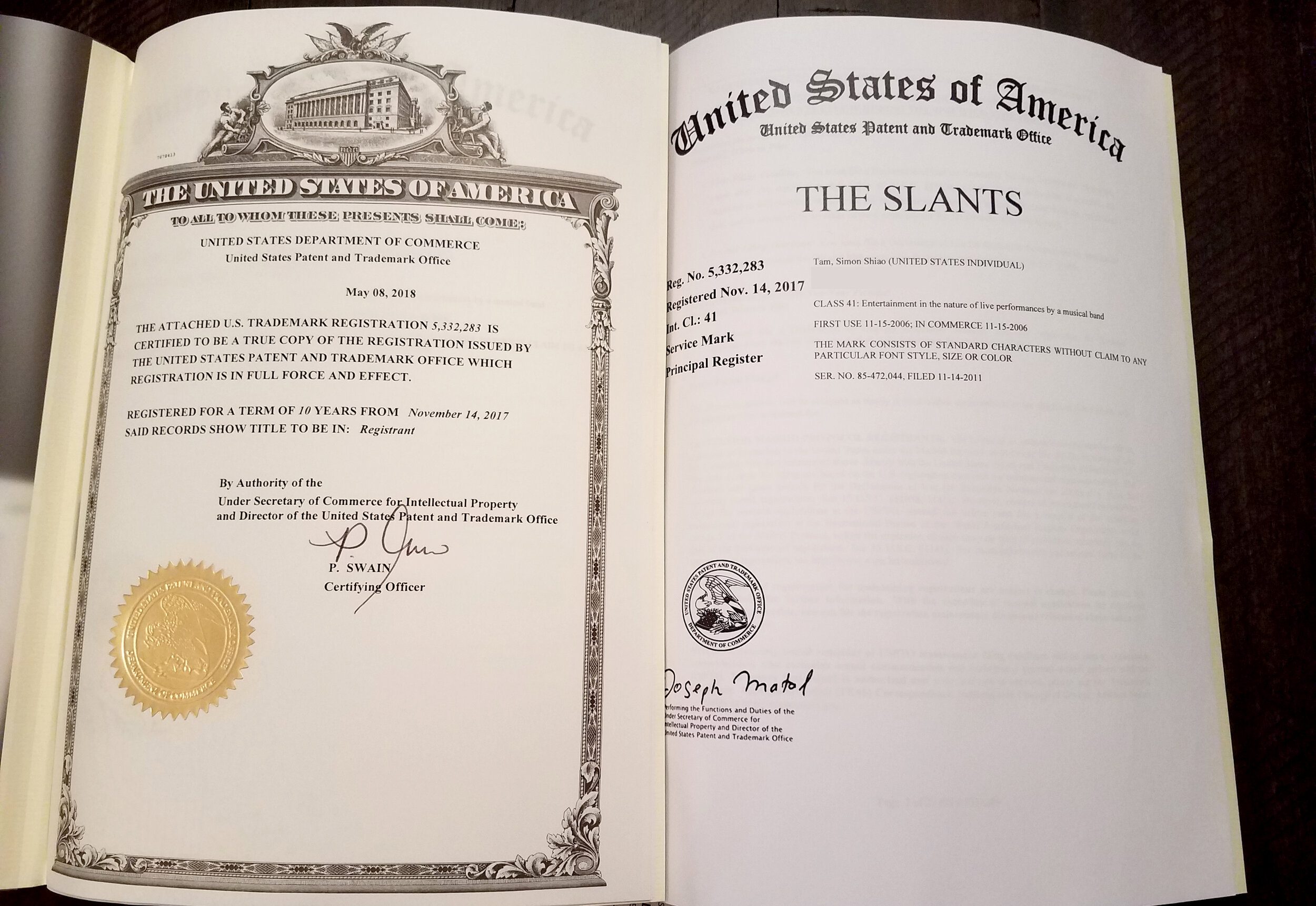
I began the paperwork to register THE SLANTS as a federal trademark in 2009 and filed the first application in 2010, the start of an eight-year fight that didn't end until the Supreme Court ruled in 2017. The government's position did not change at any level it was litigated, and even the Supreme Court never had to disagree with the underlying claim that THE SLANTS was disparaging in order to rule for me. The Court didn't need to resolve whether the mark was actually disparaging at all. It held that the government had no constitutional authority to deny a trademark on that basis in the first place, regardless of whether the underlying finding was right.2 After the initial rejection, we filed a second application using a different legal approach, a deliberate change in tactic, and that second filing gave the case the procedural shape it ultimately took through the appeals board, the Federal Circuit, and the Supreme Court. I've laid out those mechanics in detail elsewhere and won't repeat the walk-through here.3 What the legal record doesn't capture is what those eight years actually cost, and that's what I want to spend this piece on instead.
What Nobody Tells You Before You Sue
I get asked, often, whether I'd do it again, knowing what I know now.4 The honest answer is more complicated than a clean yes or no. If I, as I was then, a young punk trying to make a difference through music, had known what the fight would actually take, the bankruptcy I came close to, the friendships it cost, the way it eventually helped pull the band apart, I would have said no. That version of me wasn't ready for it. But the fight changes you. You dig in. You start to understand the larger principles underneath what felt, at first, like a fight over a band name, and somewhere in those eight years I became someone who could finish what I'd started, even though that wasn't the person who began it. I'm proud now, and glad I did it. But the person glad about it isn't quite the same person who filed the original paperwork in 2009.
This is the part most accounts of "winning" a Supreme Court case skip past, and it's the part this series has tried hardest to recover for every plaintiff in it, not just me. A win is real. It is also frequently not free, and the people who pay for it are rarely compensated in proportion to what the fight took from them. By the time the dust settled and I actually held the registered trademark in hand, the thing the entire fight had been about, I was already preparing to retire the band. The case became a citation, a name people recognize without recognizing the person, while the actual reason for fighting it had quietly stopped existing by the time the fight was finally over.
What Winning Actually Looked Like
I want to depart here from the structure the rest of this series has used, because most of the other pieces end with what happened to the case after the ruling, in doctrinal terms. I can tell you that briefly, and then tell you what happened to me, since the second part is what a legal summary can't capture.
I used to describe the case's journey like this: it began as an ax, the broad argument we first made, and by the time it reached the Supreme Court, it had been sharpened into something closer to a razor blade, a narrow holding most trademark lawyers expected to stay contained to one seldom-used statute. The actual holding was straightforward: the Court found that the disparagement clause let the government deny a legal benefit based on viewpoint, and that the First Amendment doesn't allow that, no matter how offensive the government considers the underlying speech. It didn't stay contained. The case now shows up in disputes about social media regulation, professional speech, and government coercion of private speakers.5 NIFLA v. Becerra cited it striking down a California disclosure law; Shurtleff v. City of Boston relied on its warning against treating government facilitation of private speech as government speech itself; NRA v. Vullo cited it for the principle that government can hold its own views but can't use its power to suppress speech it disfavors. The same underlying principle echoes through broader speech debates well outside trademark law, too, including a fight over rap lyrics used as criminal evidence, Knox v. Pennsylvania, where I joined an amicus brief alongside Chance the Rapper, Killer Mike, and Luther Campbell, arguing the government shouldn't get to treat one expressive form as presumptively literal without engaging in the same kind of content discrimination the disparagement clause practiced.6 None of this is uncomplicated; the same reasoning also helped clear a path, briefly, for the Washington NFL franchise to keep a name plenty of people, myself included, found genuinely racist. I think that's the actual cost of having a principle at all, rather than a list of exceptions that only protects speech the powerful already approve of.
Now, the part the doctrine doesn't capture. I sat through oral argument before eight justices, not nine, since Justice Scalia had died the previous year and the Senate had refused for nearly the entire term to hold hearings on a replacement, leaving the Court in a stretch of real uncertainty that included a handful of 4–4 splits in unrelated cases during that same period. I listened to a roomful of lawyers debate what my band's name meant and whether my own stated intentions even mattered, with no opportunity to correct anyone myself.7 The case became "a constitutional landmark studied by people who often know the doctrine better than the story," and closing that gap is what I've spent years since trying to do.8
The Slants eventually retired. The litigation nearly bankrupted me, cost me friendships and, eventually, band members who couldn't stay through nearly a decade of uncertainty, and the case outlived the band by years.9 Years later, adapting the experience into Slanted: An American Rock Opera meant watching someone else sing words I'd written from inside that fight, a small, fitting echo of the original problem.10
Not Everyone Agreed I Should Fight This
It would be dishonest to suggest my own community was uniformly behind me. Surveys taken while the case was pending found something close to ninety percent support among Asian Americans polled, but broad sentiment and organized institutional response are different things. Asian Americans Advancing Justice–AAJC filed a brief in support of neither party, laying out the community's competing interests, combating slurs aimed at minority groups on one hand, protecting the right to reclaim language on the other, without taking a side on the outcome. The Fred T. Korematsu Center for Law and Equality filed a brief actually in support of the government's position against me, a detail that sits with its own quiet irony given Karen Korematsu's personal support for me over the years; institutions and the people who carry a family's name don't always move in the same direction, even when that name is the same one this series has already spent a full piece on.
NAPABA's involvement has a more specific story behind it, and it's worth telling in full because it complicates any easy reading of "the bar association turned on me." NAPABA's own members had been enthusiastically supportive of me and the band for years. The organization ultimately filed an amicus brief against me anyway, the result of an internal campaign by a single individual within the organization who felt passionately, and sincerely, that I was in the wrong. That person retained an attorney to draft the brief on the organization's behalf. Years later, at an Inn of Court event in Georgia, that same attorney heard my full story for the first time, in detail, and told me directly that he regretted having written it. I share that not to score a point against him, he came to that regret on his own, unprompted, but because it says something true about how institutional positions get formed: sometimes by careful deliberation, and sometimes by one determined person's conviction outpacing everyone else's chance to actually look at the full record first.
Much of the loudest public friction, though, came less from genuine division than from how the press framed the case, repeatedly pairing it with the fight over the Washington NFL team's name, which made plenty of quiet supporters uneasy about saying so out loud. I understood all of it, even the parts that stung, because it echoes something this series keeps documenting: a community is never simply unanimous about how to respond to its own mistreatment. The Lum family's strategy in Gong Lum v. Rice made plenty of people uncomfortable then and since. The JACL spent the early years of the wartime cases actively discouraging Hirabayashi and Yasui's resistance, before reversing that position decades later. My case sits in that same lineage.
The loudest voice against me, though, was the most powerful one in the room: the federal government itself, whose Department of Justice argued against me at the Court. And even that wasn't simple. The same administration was, at almost the same moment, inviting my band to record a song for its own anti-bullying campaign, a track that functioned as an open letter to the very Trademark Office fighting us, released one month before I argued against that government at the Supreme Court.11 That wasn't the only contradiction. After Judge Denny Chin's son, Lieutenant Denny Chin, died by suicide while serving overseas, that same administration hired our band to perform for American troops and provide goodwill to NATO forces during the holidays, even as its Justice Department was simultaneously telling the nation's highest court that my band's name didn't deserve First Amendment protection. I don't think any of this means anyone acted in bad faith. I think it's an accurate picture of how large institutions actually work, full of offices that don't talk to each other, pulling in different directions even when nominally on the same team.
I also didn't get to choose, entirely, what kind of case mine would become. Fred Korematsu was approached in jail by a lawyer looking for a test case. Mitsuye Endo was selected specifically because her loyalty was hardest to dispute. I applied for a trademark because I wanted my band to have one, not to make a First Amendment case, and the case found its own shape through years of appeals and a circuit split that I didn't control from the outset. What I controlled was only whether to keep going. I kept going.
The Same Carelessness, a Different Court
Several pieces ago, in this series' account of Yick Wo v. Hopkins, I noted a small, almost comic detail: a sheriff who saw a laundry's sign, "Yick Wo," and simply assumed that was the proprietor's name, carrying that error permanently into the United States Reports because nobody along the way bothered to ask the man what he was actually called. I wrote, at the time, that the carelessness behind that mistake "shows up again much later in this series, in a case far closer to home." This is that case. The error here isn't a sheriff's. It's the Supreme Court's own, printed in the official syllabus of its own opinion: "lead singer," not bassist, not founder, a detail that would have taken one phone call or one accurate citation to a lower-court filing to get right, in a case that was, from beginning to end, about who has the standing to define an identity and correct the record when someone more powerful gets it wrong. The error has since been repeated in hundreds of law review articles, casebooks, and classroom materials, because once something enters the official record, it tends to get cited rather than re-verified.
A few pieces after mine, this series covers Students for Fair Admissions v. Harvard, where a different kind of small error travels a similar path upward: a statistic widely repeated as settled fact, an 11.1 percent figure, though it actually comes from a litigation simulation in a lower-court record, contested in its assumptions, and treated by commentary on every side as something closer to a fixed, court-certified number than it really is. That's not quite the same kind of error mine was; the figure is real and defensible as one reading of the trial record, where "lead singer" was simply wrong. But both started small, at a level few people scrutinize closely, and calcified the further they traveled from their original source.
I want to be careful not to blur two different things together here, because they're related but not identical. One is carelessness: a sheriff who doesn't ask a question, a syllabus writer who doesn't check a citation, an error that repeats because nobody downstream has the incentive to verify it. The other is power: the deeper fact that institutions get to define people and communities in the first place, correctly or not, and that the people being defined rarely have an equal voice in correcting the record once it's set. Mississippi misclassified the Lum family's race without asking what they actually were, which is both. A federal commissioner decided twenty-two women were "lewd" without anything resembling an actual inquiry, which is both as well. And the Supreme Court of the United States, in a case specifically about whether the government gets to decide what a marginalized community's chosen words mean, simply got which instrument I played wrong, a small carelessness sitting inside a much larger exercise of power over what my band's name was allowed to mean.
Where This Leaves the Question
This series opened by asking whether America belongs to Asian Americans on the same terms it belongs to everyone else, and noted, early on, that not one Asian American has ever sat on the Supreme Court deciding that question. I don't think that's incidental to anything in this piece, or to anything in this series. A court without anyone who has lived a question from the inside will keep deciding it from the outside, carefully, sometimes correctly, and it will still keep getting small things wrong: a name, an instrument, a job title, a date, the difference between an organization's actual position and the position the loudest person inside it managed to push through. Representation wouldn't end the mistakes; the Court will misname people and misjudge intentions even with an Asian American justice on the bench, because institutions this large make that kind of error regardless of who is sitting where. The real claim I want to make is narrower and, I think, more durable: representation changes who gets to catch the mistake before it calcifies into the official record, not whether mistakes happen at all. That's a difference in correction, not in perfection, and it's worth wanting on its own terms.
Until that changes, the record will keep needing people willing to go back and fix it. That's true of every case in this series, not just mine. Someone will keep fighting for a name. Someone will keep fighting for the right to be recognized as a citizen, or a parent, or a loyal American, or simply as themselves, regardless of the cost, regardless of whether the fight ever makes it past a clerk's desk or into a published opinion at all. I got my trademark. The record still says I was the lead singer. Both of those things are true at once, and I've come to think that's not a contradiction so much as the most honest possible place to leave a series built around a question that, a hundred and fifty years on, still doesn't have a clean answer.
Related Cases and Precedents
Iancu v. Brunetti (2019) — Extended this case's reasoning to strike down the Lanham Act's separate bar on "immoral" or "scandalous" trademarks, confirming the disparagement clause ruling wasn't a one-off but a durable First Amendment principle.
Pro-Football, Inc. v. Blackhorse — The long-running fight over the Washington NFL team's trademark, cancelled under the same disparagement clause this case struck down; the cancellation could not survive once the underlying provision was gone. The team eventually changed its name anyway, not because of any court ruling but through years of sustained market and social pressure, part of a broader wave in which numerous other racist team names and mascots across the country fell during the same period.
Vidal v. Elster (2024) — Decided seven years later, this case upheld a different Lanham Act provision on historical-tradition grounds rather than this case's viewpoint-discrimination framework, confirming the Court still hasn't settled on one unified theory connecting trademark law to the First Amendment.
Yick Wo v. Hopkins (1886) — This series' earlier piece on Yick Wo noted that a small, careless error about a plaintiff's actual name and identity would resurface "in a case far closer to home." This is that case.
Sources and Further Reading
For deeper reading:
Simon Tam, Slanted: How an Asian American Troublemaker Took on the Supreme Court (Audible Originals, 2019)
Simon Tam, "First Amendment, Trademarks, and the Slants: Our Journey to the Supreme Court," Buffalo Intellectual Property Law Journal (2018)
FIRE's case archive on Matal v. Tam, including full opinion text and briefing
Simon Tam's continued writing on the case's legacy at simontam.org/blog
Footnotes
Simon Tam, Slanted: How an Asian American Troublemaker Took on the Supreme Court (Troublemaker Press, 2019); Simon Tam, TEDxSpokane talk on reappropriation and identity. ↩
Matal v. Tam, 582 U.S. 218 (2017), quoting PTO guidance on the disparagement clause's application regardless of an applicant's group membership or intent; In re Tam, 785 F.3d 567 (Fed. Cir. 2015) (panel decision); In re Tam, 808 F.3d 1321 (Fed. Cir. 2015) (en banc). ↩
Simon Tam, "What Matal v. Tam Actually Decided — And What It Didn't," simontam.org, for the full procedural and doctrinal history. ↩
Los Angeles Review of Books, "Bending Toward Justice: A Conversation with Simon Tam." ↩
Simon Tam, "Nine Years Later, Matal v. Tam Is Still Rewriting Free Speech Law," simontam.org (forthcoming). ↩
Id., on NIFLA v. Becerra, 585 U.S. 755 (2018); Shurtleff v. City of Boston, 596 U.S. 243 (2022); NRA v. Vullo, 602 U.S. 175 (2024); and the amicus brief in Knox v. Commonwealth of Pennsylvania. ↩
Simon Tam, "What Matal v. Tam Actually Decided — And What It Didn't," simontam.org. ↩
Simon Tam, "What Matal v. Tam Actually Decided — And What It Didn't," simontam.org. ↩
Willamette Week, "Simon Tam's Memoir Closes the Book on His Band the Slants' Long Legal Fight—and Their Career." ↩
Simon Tam, "Nine Years After the Supreme Court, Watching Someone Else Sing My Words," simontam.org. ↩
SCOTUSblog, "Matal v. Tam (15-1293)," docket showing Asian Americans Advancing Justice, et al. filing in support of neither party, and the Fred T. Korematsu Center for Law and Equality filing in support of petitioner; NBC News, "Jeremy Lin, President Obama Join Celebrity-Filled Anti-Bullying Album," on The Slants' single "From the Heart" appearing on the #ActToChange compilation alongside tracks and messages from Jeremy Lin, George Takei, Run River North, Dia Frampton, and President Obama. NAPABA amicus filing and the account of its internal origin per Simon Tam's own recollection. ↩