Equal Access, Decided Without the Constitution
Lau v. Nichols (1974)
In 1970, a lawyer named Edward Steinman was representing a woman named Kam Wai Lau in an ordinary landlord-tenant dispute, the kind of case that rarely becomes a footnote in anyone's life, let alone a Supreme Court citation. By one frequently repeated account of how the case began, Steinman learned in the course of that work that her son, a first grader named Kinney Kinmon Lau, had recently arrived from Hong Kong speaking almost no English, and was sitting in a San Francisco classroom where every lesson was taught in a language he couldn't follow.1 Steinman asked whether she would be willing to join a lawsuit. She said yes, and gave a reason that had nothing to do with constitutional doctrine: her son's teachers had told her she needed to do something for herself, because she'd seen other children in the same position "crying and unhappy."2 Steinman placed Kinney's name first on a list of thirteen plaintiffs. Four years later, the case that bore his name reached the Supreme Court, and reshaped how courts and school districts across the country understood what equal access to education actually requires.
A City That Integrated Without a Plan for Language
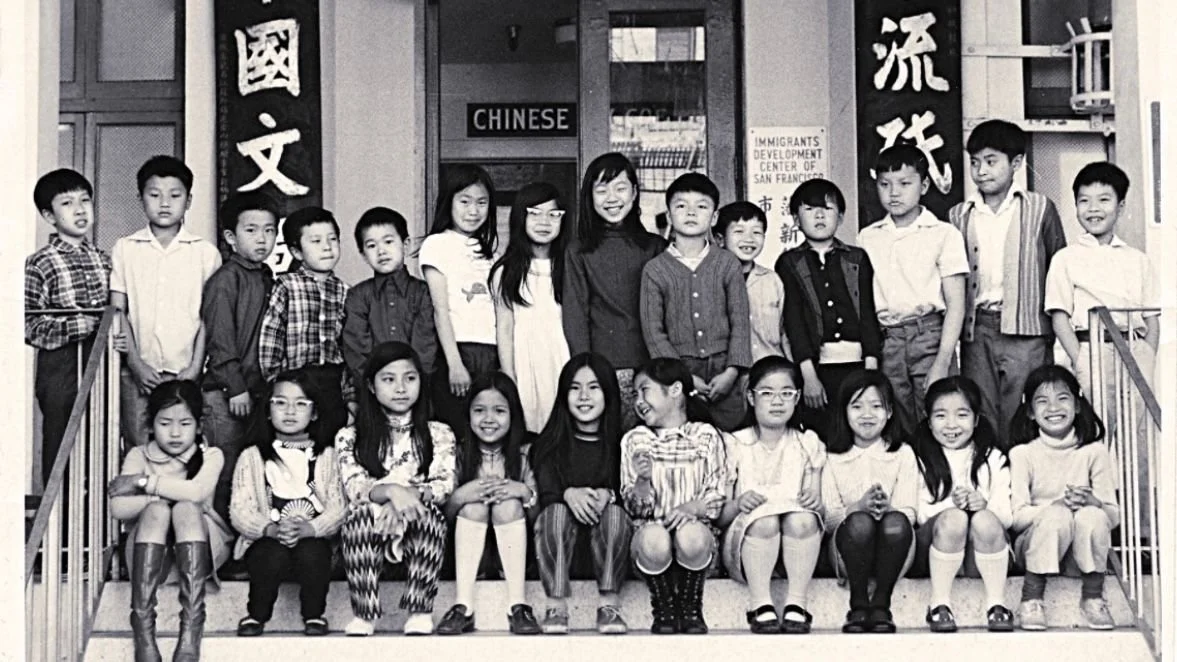
The case existed because of an earlier one. In 1971, San Francisco's school system desegregated under a federal court order, Lee v. Johnson, redistributing students out of overcrowded, segregated Chinatown schools and into the broader district.3 The integration order solved one problem and created another. Nearly 2,900 students of Chinese ancestry who spoke little or no English were absorbed into a system that had no comprehensive plan to serve them. Of those students, roughly 1,000 received some supplemental English instruction. The remaining 1,800 or so received none at all.4 They sat in classrooms taught entirely in English, using textbooks written in English, given instructions in English, expected to perform on the same terms as their English-speaking classmates, with no acknowledgment that the terms themselves made participation impossible.
Not Every Chinese Family Wanted to Be Dispersed
It's worth pausing on that same desegregation order before moving on, because not every Chinese family in San Francisco experienced it as Kinney Lau's family did. The order that swept Lau into an English-only classroom also reassigned children out of schools that were, for many families, the center of a Chinese-speaking community they had built deliberately and valued on its own terms. A group of Chinese American parents, in a case styled Guey Heung Lee v. Johnson, sought an emergency stay of the same reassignment order, arguing that dispersing their children out of majority-Chinese schools would dilute exactly the cultural and linguistic continuity those schools provided.5 Justice William O. Douglas, the same justice who would write the Lau opinion three years later, heard the stay application as circuit justice for the Ninth Circuit and denied it, writing in terms that left no room for the parents' argument to prevail: "Brown v. Board of Education was not written for blacks alone. It rests on the Equal Protection Clause of the Fourteenth Amendment, one of the first beneficiaries of which were the Chinese people of San Francisco," citing Yick Wo v. Hopkins directly.6 The desegregation order proceeded.
The two cases are easy to read as opposites, and in a narrow procedural sense they were: one set of Chinese parents wanted their children kept together in a Chinese-majority school: the other wanted language support inside whatever school their children ended up in. But they were really arguing about the same underlying problem from two different sides of it. Both groups were responding to a desegregation plan built, like the language barrier Lau would later address, without much apparent thought for what the Chinese community in San Francisco actually needed, whether that meant linguistic support after reassignment or the choice to not be reassigned at all. Douglas's opinion in the stay case treated the question as already settled by Brown, the same precedent his own Lau opinion would later expand on, this time in the opposite direction, toward acknowledging that formal equality wasn't always the same thing as actual access. Read together, the two cases say something true about integration policy generally: a remedy built for one kind of harm can create real costs for the very community it's meant to help, and a city implementing it from the outside rarely gets to anticipate which kind of cost will land on which family.
Kinney Lau's first-grade teacher at Jean Parker Elementary, a young instructor named Lucinda Lee Katz, watched this happen to her own student. Mrs. Lau told her directly: in Hong Kong, children moved between languages as a matter of course; she didn't understand why the same thing couldn't happen in San Francisco, and she worried her son was falling behind in subjects like math simply because he couldn't understand the language they were taught in.7 By Katz's own later account, that conversation eventually made its way to Steinman through a personal connection, turning a single worried mother's question into the beginning of a four-year legal campaign.8
Steinman built his case on a deliberately narrow set of facts and a far broader idea. The narrow facts: roughly 1,800 students, identifiable, countable, denied any language support at all. The broader idea, one Steinman later described as the case's real intellectual contribution: most discrimination law up to that point, following Brown v. Board of Education, addressed the problem of taking people who were the same and treating them differently. Lau's case was about the opposite and, in his view, equally serious problem: taking people who were different, in this case in the one respect that mattered most for a classroom, the language they understood, and treating them exactly the same.9Sameness, applied to a real difference, didn't produce equality. It produced exclusion dressed up as fairness.
Both the district court and the Ninth Circuit Court of Appeals rejected this argument outright. The Court of Appeals went further than simple rejection; it held that the language barrier these children faced was, in its own words, "the result of deficiencies created by the children themselves in failing to learn the English language."10 The students' own inability to speak English, in other words, was their own fault, and the school district's obligation ended at providing the same materials and the same teachers it gave to everyone else.
A Decision That Didn't Wait
The Supreme Court disagreed, unanimously. The case was argued December 10, 1973, and decided January 21, 1974, a turnaround of just over a month, fast by the standards of the most closely watched constitutional cases, though not unusual for a unanimous decision resolved on relatively narrow statutory grounds.11 Justice William O. Douglas wrote for the Court: "There is no equality of treatment merely by providing students with the same facilities, textbooks, teachers, and curriculum; for students who do not understand English are effectively foreclosed from any meaningful education."12
The opinion is notable as much for what it avoided as for what it held. The students had argued their exclusion violated the Fourteenth Amendment's Equal Protection Clause, the same constitutional ground Brown itself had stood on twenty years earlier. The Court didn't touch that argument at all. It decided the case entirely on statutory grounds, Section 601 of the Civil Rights Act of 1964, which bars discrimination based on race, color, or national origin in any program receiving federal funding, and the regulations the Department of Health, Education, and Welfare had issued under it.13Because San Francisco's school district accepted federal money, the Court reasoned, it had to actually serve the students that money was meant to reach, regardless of whether anyone in the district intended to discriminate against them. Intent didn't matter. Effect did.
That distinction, avoiding the Constitution and resting instead on a federal funding statute, would prove far more consequential than it looked at the time. A constitutional ruling becomes part of the bedrock; a statutory one depends entirely on the statute staying interpreted the way the Court interpreted it. Justice Harry Blackmun's concurrence, joined by Chief Justice Warren Burger, added a detail worth sitting with: "numbers are at the heart of this case," he wrote, a line some have read as suggesting that a complaint brought by a handful of students, rather than nearly two thousand, might not have reached the same result, though Blackmun stopped short of saying so directly.14 Whatever its precise meaning, the line at least signals that scale played some role in how comfortable the Court was reaching this outcome, not simply the underlying principle on its own.
What "Meaningful Education" Built, and What Undid It
The ruling itself didn't specify a remedy. It sent the case back to the district court with instructions to figure out an appropriate fix, leaving open whether that meant teaching the students English, teaching some subjects in Chinese, or some combination neither side had fully argued.15 What followed was a federal guidance document known as the Lau Remedies, issued by HEW's Office for Civil Rights in 1975, which gave school districts nationwide detailed methods for identifying students with limited English proficiency and serving them.16 Congress followed with the Equal Educational Opportunities Act of 1974, expanded funding for bilingual education, and effectively extended Lau's logic to every public school district in the country, not just San Francisco's. For a generation, the case has sometimes been described as a kind of second Brown, though the comparison is contested; it was decided on narrower statutory grounds and lacked Brown's constitutional weight, but it reached deep into how American public schools were required to treat children who didn't speak the majority language.
The statutory foundation that made this expansion possible was the same foundation that, decades later, made it fragile. In 2001, the Supreme Court decided Alexander v. Sandoval, holding that private individuals could no longer sue directly to enforce Title VI's disparate-impact regulations, the same regulations Lau itself had relied on.17 Sandovaldidn't overturn Lau. It didn't need to. It held specifically that the kind of lawsuit Kinney Lau's family had brought, ordinary families suing a school district directly over an effect rather than an explicitly discriminatory intent, generally couldn't proceed that way in court anymore; federal agencies retained authority to enforce the same regulations on their own initiative, and some claims could still be reframed under other statutes. But for the families the regulations were meant to protect, the practical effect was the same: enforcement narrowed to whatever a federal agency chose to pursue, a far less reliable mechanism than the courthouse door Lau had kept open for individual families. A right that depends on agency initiative rather than a family's own ability to sue is, in practice, far harder to enforce than one a family can walk into court and assert themselves.
The Question Is Live Again
This is not a settled, historical argument. In March 2025, a presidential executive order declared English the official language of the United States at the federal level for the first time in the country's history, more than thirty states having already done so on their own.18 The order itself rescinded a Clinton-era mandate, Executive Order 13166, which had required federal agencies and recipients of federal funding to provide language assistance to people with limited English proficiency. Five months later, the Department of Justice rescinded the 2015 "Dear Colleague" guidance letter that had told school districts, in plain administrative language, much of what Lau's "meaningful access" standard required of them in practice: timely identification of English learners, research-based instructional programs, qualified teachers. Asked why, a Department of Education spokesperson pointed directly back to the English-only executive order, saying the guidance was "not aligned with administration priorities."19 Follow-up guidance from the Justice Department that July was framed around minimizing what it called "non-essential multilingual services."20 Federal funding earmarked specifically for English learners was, for a time, withheld from states before eventually being released, and faced proposed cuts in the following year's budget process.21
These are recent, still-unfolding developments rather than settled history, and how much further this rollback extends, or whether some of it reverses, remains to be seen. What can already be said is that none of it overturns Lau itself. The 1974 holding, that providing the same material in a language students can't understand fails to satisfy federal civil rights law, remains the law of the land, exactly as it did the day after Sandoval narrowed who could sue to enforce it. What has changed, at least for now, is the same thing that has changed after nearly every case in this series: not the precedent itself, but the administrative will to act on it, and the practical guidance that turns a legal entitlement into something a parent without a law degree can actually use. A right that exists on paper but depends heavily on which administration happens to be enforcing it, and how, is a pattern this series keeps finding, fifty years and a world away from Kinney Lau's first-grade classroom.
The Boy Whose Name the Case Carries
Kinney Lau did not become a symbol in the years after his case was decided. He went by Kinney, then Kenny, then Ken; he graduated from San Francisco City College with a degree in computer programming; he gave interviews, occasionally, when reporters tracked him down for anniversary retrospectives, and what he told them complicates the tidy version of his own story. He did not, by his own account, directly benefit from the bilingual programs his case eventually produced. He learned English largely by watching television, he said, because "the shows on TV are more or less how the society speaks."22 Decades later, asked by a reporter whether bilingual education had actually been the right answer, he didn't offer the confident affirmation a case named after him might be expected to provide. "I don't know if bilingual education is better," he said. "I'm still trying to work it out."23
That ambivalence is worth taking seriously rather than smoothing over. The case that bears Kinney Lau's name reshaped American education policy for half a century. The student at its center spent his own adult life genuinely unsure whether the remedy his name had attached to the country's classrooms was the right one, and said so plainly, without performing certainty he didn't feel. A Supreme Court ruling settles a legal question. It does not, on its own, settle what the people most affected by it will eventually come to believe about whether it actually helped.
Related Cases and Precedents
Brown v. Board of Education (1954) — The case Lau is most often compared to, and the comparison reveals exactly how Lau differs: Brown addressed treating the same people differently; Lau addressed treating different people the same, a distinction Edward Steinman identified as the case's central intellectual contribution.
Regents of the University of California v. Bakke (1978) — Decided just four years later, Bakke began narrowing the kind of race-conscious, effects-based remedies Lau had helped establish, part of a broader judicial retreat from disparate-impact reasoning across multiple areas of civil rights law.
Alexander v. Sandoval (2001) — Directly narrowed the enforcement mechanism Lau's victory depended on, holding that private individuals could no longer sue to enforce the Title VI disparate-impact regulations Lau itself relied on.
Gong Lum v. Rice (1927) — Decades earlier, a different Chinese American family's fight over access to a San Francisco-area school took the opposite legal shape, fighting over racial classification rather than language access, and lost; together the two cases trace how the same community's claim to equal education shifted ground across nearly fifty years.
Castañeda v. Pickard (1981) — A Fifth Circuit decision that built directly on Lau's "meaningful education" standard, establishing a three-part test still used today to judge whether a school district's program for English language learners is legally adequate.
Executive Order Declaring English the Official Language (2025) — The first such order in U.S. history, cited directly by federal officials as the basis for rescinding guidance that had told school districts how to meet their obligations under Lau and Title VI, illustrating how administrative priorities can hollow out a standing legal right without touching the precedent itself.
Sources and Further Reading
For deeper reading:
Trish Morita-Mullaney, Lau v. Nichols and Chinese American Language Rights: The Sunrise and Sunset of Bilingual Education (Multilingual Matters)
Chinese for Affirmative Action, "Lau v. Nichols" resource collection, including a community-centered illustrated zine on the case's history
EdWeek's 50th-anniversary interview series on the case's origins and legacy
Footnotes
EdWeek, "In 1974, the Supreme Court Recognized English Learners' Rights. The Story Behind That Case." ↩
EdWeek, "Languages, Law, and San Francisco," quoting Kam Wai Lau. ↩
Wikipedia, "Lau v. Nichols," on the 1971 desegregation order Lee v. Johnson. ↩
Id.; Britannica, "Lau v. Nichols." ↩
Guey Heung Lee v. Johnson, 404 U.S. 1215 (1971), statement of facts via Justia. ↩
Id. (Douglas, J., as Circuit Justice), quoting the opinion's citation to Yick Wo v. Hopkins, 118 U.S. 356 (1886). ↩
EdSource, "Q&A: How the 50-year-old case that transformed English learner education began," interview with Lucinda Lee Katz. ↩
Wikipedia, supra note 3, on Katz's role in connecting the issue to Edward Steinman. ↩
Stanford Magazine, "A Young Lawyer Wins an Educational Equity Case," quoting Edward Steinman. ↩
EdSource, supra note 5, quoting the Ninth Circuit's opinion. ↩
Oyez, "Lau v. Nichols."; EdWeek, supra note 1. ↩
Lau v. Nichols, 414 U.S. 563 (1974), quoted in EdSource, supra note 5. ↩
Lau v. Nichols, 414 U.S. 563 (1974). ↩
Alchetron, "Lau v. Nichols," quoting Justice Blackmun's concurrence. ↩
Lau v. Nichols, 414 U.S. 563 (1974). ↩
Alchetron, supra note 12, on the Lau Remedies and the Equal Educational Opportunities Act of 1974. ↩
Alexander v. Sandoval, 532 U.S. 275 (2001). ↩
Wheelock College of Education & Human Development, "What's Next for English Learners in the US Now that English is the Official Language?"; KFF, "Designating English as the Official Language of the United States Could Impact Millions with Limited English Proficiency," on the rescission of Executive Order 13166. ↩
EdWeek, "Trump Admin. Quietly Rescinds Guidance on English Learners' Rights," quoting a Department of Education spokesperson, August 2025. ↩
Id., on Department of Justice guidance issued July 2025. ↩
Wheelock College, supra note 16, on Title III funding status and proposed cuts. ↩
EdWeek, "In 1974, the Supreme Court Recognized English Learners' Rights. The Story Behind That Case."quoting Kinney Lau's 1984 interview with Education Week. ↩
Id., quoting Kinney Lau's 2002 interview with the Boston Globe. ↩