Nine Years After the Supreme Court, Watching Someone Else Sing My Words
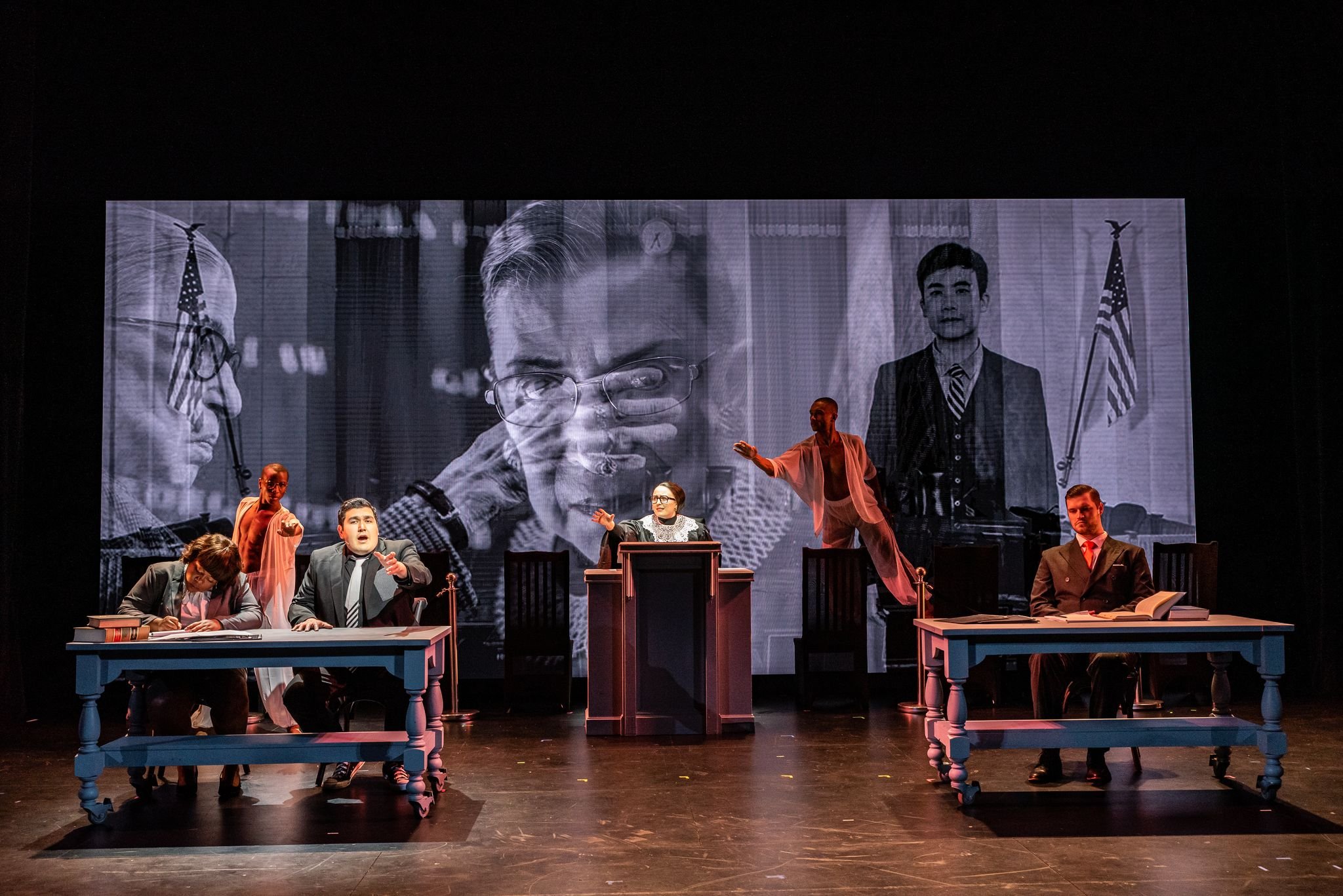
Slanted: An American Rock Opera
There's a tenor named Matthew Pearce. I watched him stand on a stage in St. Louis, dressed as a version of me, and sing words that I had spoken — words I'd turned over in my head in hallways and courtrooms and sleepless nights for years. I've shared some of those words on stages, at legal conferences, at countless colleges and universities, as I stared the firsthand account for Matal v. Tam.
No, that is not me that you're speaking of.
No, you don't know our community.
Who are you to decide what is offending us?
Who are you to control our story?
I wrote those lyrics. They came from something real — from the specific, strange invisibility of being the named plaintiff in a case where everyone seemed to be speaking about you but never quite to you. I was sitting in the nation's highest court, fighting for freedom of speech — but in that room, I couldn't say a thing.
But hearing them sung back to me, by someone else, on a stage — I felt surprisingly emotional. Not because it was moving in the way a good performance is moving. Because for the first time, I felt genuine empathy for that person. The one who went through all of it. He felt, from a distance, like a character I recognized but was no longer living inside.
That's probably the truest thing I can say about what nine years feels like.
— — —
June 19th keeps arriving. Nine years ago, to this day, the Supreme Court issued a unanimous opinion in Matal v. Tam, striking down the federal government's power to refuse trademarks it found "disparaging." June 19th, Juneteenth of all days, was when the Supreme Court opinion was delivered. My band, The Slants, won. The First Amendment won. I wrote about what the Court actually decided in last week's post — the legal substance is there if you want it. And of course, I wrote a whole lot more about the years leading up to that day.
This post is about something different. It's about what winning actually looked like afterward, which is not the story people expect.
People expect a clean ending. The case concludes, the band gets the trademark, the troublemaker takes a bow. What actually happened is that I kept going (even after the band retired) — and the case kept going, in ways I didn't control.
New briefs. New citations. Iancu v. Brunetti in 2019, which extended the ruling to "immoral" and "scandalous" marks. Work with the Rap on Trial amicus cases. Filings in support of artists and communities whose creative expression ran up against institutional gatekeeping of one kind or another. The case became a tool that outlived the moment that produced it, and I found myself returning to it not out of nostalgia but because I was still being asked to do work from it.
I'd always said I was willing to share my story if people found value in it. What I've come to understand is that what I actually mean is something more specific: I'm willing to return to that story when it helps people find themselves in it. When it becomes a way of showing how we're connected in community, in common struggle, in the patience and persistence that change actually requires.
The opera clarified this for me in a way nothing else had.
When the Opera Theatre of St. Louis came to me in 2022 about commissioning a work based on the case, I didn't immediately see the fit. Opera wasn't a world I'd imagined inhabiting. But the Asian American community there had found something in the story that mattered to them, and that was reason enough to try. My co-creator Joe X. Jiang and I joined the first cohort of the New Works Collective and gave ourselves permission to go big, to use the theatrical scale of opera to do what the legal record couldn't: capture the inner experience of the thing.
We leaned into the contradiction of it: The oral arguments at the Supreme Court, set against what I was actually feeling, invisibly, in the same room. At the end of the opera, we sing a reprise of “That is Not Me,” the pronouns shifting. From I to we. From me to us. It wasn't a device, it was the point.
A woman came up to me after one of the performances and said it was the first time she'd seen an Asian person at an opera who wasn't playing a servant. That's one version of why it mattered. But the people who came up to me across every showing weren't all Asian American. They were people who had felt unseen in rooms where decisions about them were being made. That, it turns out, is not a niche experience.
The right to name yourself — to choose your own identity, to tell your own story — is a basic human right. The case made that argument in trademark law. The opera made it in music. The memoir made it in prose. I've tried to make it in classrooms and conference rooms and law schools and anywhere else the conversation has been worth having. The form changes, but the argument and its central values, remain the same.
I've moved all over North America since 2017. I've composed music that has nothing to do with civil liberties. I run The Slants Foundation as its volunteer Executive Director. I've become, to my occasional bewilderment, the subject of other people's books and my story is assigned reading in thousands of classes I'll never visit, cited in briefs written by people I've never met.
There's pride in that. There's also something that resists easy categorization. I am not the person who stood in that courtroom. That person is a character now — one I can watch from a seat in the opera, one I can feel something for. The work continues, but I carry it differently.
Justice isn't a destination. The arc bends slowly, and you have to keep bending it, and the bending is most of the work. If the case taught me anything that has stayed genuinely useful, it's that. Not the outcome — the patience it took to get there, and the recognition that getting there wasn't the end of anything.
Nine years later, the most important thing I know about that chapter of my life is that it belongs to more people than just me. The choir made that clear:
There will be some long and dark nights
Sometimes it’ll feel like a losing fight
Who is affected? Who makes decisions?
Who gets to decide what is right?
No, that is not us that you are speaking of
No, you don’t know our community
Who are you to tell our stories?
Who are you to decide our future?
You can watch Slanted: An American Rock Opera here.
If you're working on free speech, IP law, or creative rights curriculum and want to bring this conversation into your classroom or program, visit simontam.org/for-educators.