
What Counts as Proof You Belong
Lem Moon Sing v. United States (1895) · Wong Wing v. United States (1896) · United States v. Sing Tuck (1904) · United States v. Ju Toy (1905) · Kwock Jan Fat v. White (1920) · Yee Won v. White (1921)
A different piece in this series, on Takao Ozawa and Bhagat Singh Thind, asked what the Supreme Court thought a person had to be to count as white. This piece asks a narrower, colder question: once you already are who you say you are, who gets to decide whether you're allowed to prove it, and where. Across six cases and twenty-six years, the answer to that question moved almost entirely in one direction, away from the people trying to come home, with exactly one real exception along the way.
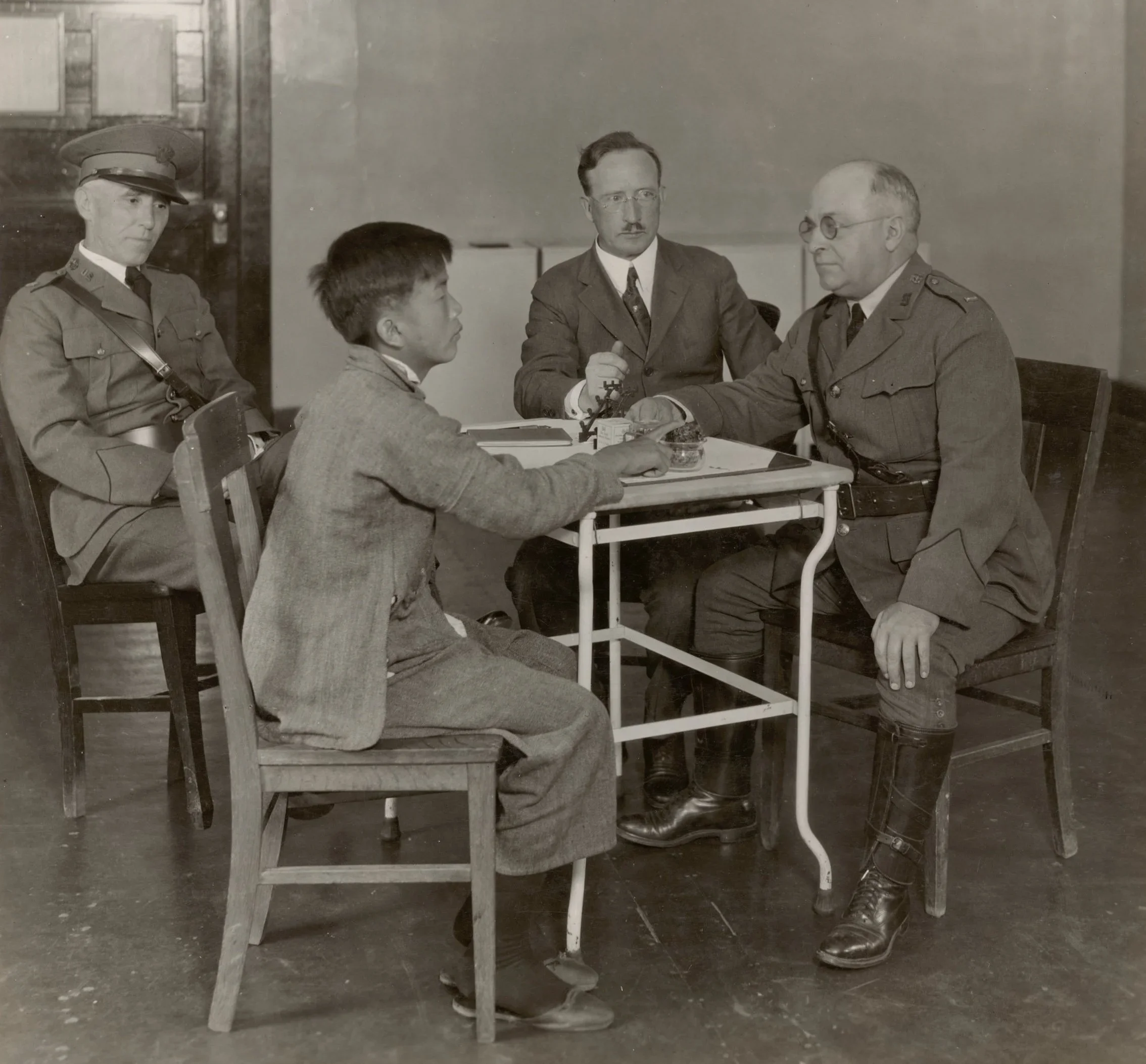
A Druggist on the Belgic
Lem Moon Sing ran a wholesale and retail drug business in San Francisco, a partner in a firm called Kee Sang Tong & Co., for more than two years before he left for a visit to China in January 1894. He intended to come back. Chinese merchants already faced increasingly restrictive admission rules by this point, but nothing in the law at the time he departed suggested that an immigration officer's decision about him would become effectively immune from judicial review before he made it home. While he was away, Congress enacted a provision making exclusion decisions final, subject only to limited administrative appeal, a change to the underlying machinery rather than to the merchant exemption itself.1
Lem Moon Sing returned that November aboard the steamship Belgic, the same ship Chae Chan Ping would have sailed on six years earlier had Congress not voided his certificate while he was at sea. He had two non-Chinese witnesses ready to testify he'd been exactly what he said he was: a merchant, not a laborer, the one category the Chinese Exclusion Act still let back in. The collector of customs denied him anyway. When his case reached the Supreme Court in 1895, Justice John Marshall Harlan, writing for a unanimous Court, didn't examine the merchant testimony at all. He held that Congress's power to exclude foreigners extended far enough to give immigration officials extremely broad, largely unreviewable authority over factual questions like this one, sharply limiting what a federal court could do about it afterward.2 The opinion never says whether Lem Moon Sing actually was a merchant. It says the question stopped mattering nearly as much the moment Congress decided it would.
The One Place the Line Held
The following year produced the cluster's single real exception, and it's worth pausing on precisely because it shows the Court was capable of drawing a limit when it chose to. Wong Wing, Lee Poy, Lee You Tong, and Chan Wah Dong were arrested in Detroit in 1892, found by a federal commissioner to be Chinese laborers unlawfully present under the Geary Act, and sentenced, without a jury trial, to sixty days of imprisonment at hard labor before deportation.3 Their habeas petition reached the Supreme Court in 1896, and this time the Court drew a real line, distinguishing between two different government powers it had already blessed separately: the power to exclude and deport noncitizens, which Congress could exercise through executive officers without a jury, and the power to punish someone criminally, which the Fifth and Sixth Amendments required a real trial to impose, regardless of whether the person being punished was a citizen at all.4 Justice George Shiras, writing for a unanimous Court, held that hard labor was a punishment in the constitutional sense, not merely an administrative incident of deportation, and that imposing it on these four men without an indictment or a jury violated rights the Constitution extended to "any and every human being within the jurisdiction of the republic," not citizens exclusively.5
It is worth being precise about how narrow this victory actually was, because the surrounding cases in this cluster make the boundary obvious. The Court did not question Congress's underlying power to exclude or deport Chinese immigrants summarily, the same power Fong Yue Ting had already settled three years earlier, and it said so directly, treating that power as too well established to need re-argument. It drew its line at one specific consequence, punitive hard labor, that crossed from immigration enforcement into ordinary criminal punishment, a category the Constitution had always required a trial for, regardless of who was being punished. Wong Wing and the three other men still faced deportation. They simply didn't have to serve sixty days of hard labor first. The same Court that would go on, within a decade, to make it nearly impossible for a Chinese citizen to get a judge to even hear a citizenship claim drew this one boundary clearly and never significantly widened it.
Thirty-Two Men Who Wouldn't Answer
Nine years later, a group of Chinese immigrants tried a different approach, and it went worse. In 1904, thirty-two men arrived from China by way of Canada, claiming citizenship by birth. Some answered an immigration inspector's questions about their birthplace; others gave only their names and went no further, declining to participate fully in the administrative process while simultaneously seeking a court's intervention.6 The inspector denied them entry, and the case, United States v. Sing Tuck, took the name of the first man listed among them, a man about whom almost nothing else survives in the historical record.
Justice Oliver Wendell Holmes, writing for the majority, held that a mere claim of citizenship wasn't enough to get a hearing in front of a judge; the men had to exhaust the appeal process Congress had set up, all the way to the Secretary of Commerce and Labor, before a court would even consider stepping in.7 Justice David Brewer, joined by Justice Peckham, dissented, and his words cut through the case's bureaucratic language with more force than almost anything written in the majority opinion: "I cannot believe," he wrote, "that the courts of this republic are so burdened with controversies about property that they cannot take time to determine the right of personal liberty by one claiming to be a citizen."8 He was outvoted, the same as he'd been outvoted dissenting in Fong Yue Ting a decade earlier, a case his own dissent here points back to directly. The pattern by now should be familiar to anyone who has read this series in order: a justice sees the cost clearly, says so on the record, and loses anyway.
The Number That Says What the Cases Don't
A year later, the door closed further, and on a sharper question than Lem Moon Sing's or Sing Tuck's. Ju Toy, a man whose full biography has not survived any better than Sing Tuck's, returned to San Francisco from a trip to China in 1905, claiming native-born citizenship, the exact status Wong Kim Ark had already settled was his constitutional right if true. A federal district court initially agreed, finding as a matter of fact that he was a citizen, and ordered his release. The government appealed, and the Supreme Court, in an opinion by Justice Holmes again, reversed.9 The shock of the ruling wasn't simply that an immigration officer's finding controlled. It was that even someone asserting the specific constitutional right Wong Kim Ark had guaranteed could be denied a full judicial trial of that claim, so long as the administrative process behind the finding hadn't itself shown fraud or denied him a fair hearing. Citizenship by birth, a substantive right this series has already traced back to its own case, turned out to mean very little in practice without a reliable way to get a court to actually decide whether you held it.
Contemporary scholars have treated what followed as a direct consequence of this ruling: attorneys representing Chinese clients increasingly concluded that habeas petitions challenging exclusion decisions had become close to futile. Habeas corpus petitions filed in the Northern District of California fell from 153 in 1904 to 32 in 1905, the year Ju Toywas decided, to 9 in 1906.10 That decline is not, in the scholarship that has examined it, treated as a coincidence of timing. It is the visible shape of a door closing, one ruling at a time, on the only mechanism Chinese American citizens had ever had to ask a federal judge whether the government was right to call them foreigners.
A Win, Fifteen Years Later, That Still Wasn't Enough
By 1920, the doctrine had shifted just enough to let one more case through the gap, and it's worth sitting with why this one succeeded where the others hadn't. Kwock Jan Fat applied in 1915 to leave the country temporarily and return as the citizen he'd already been recognized as, born in Monterey, California, the son of a man who had lived there for decades. Immigration officials approved his preinvestigation, took testimony from his mother, his alleged brother, and three white residents of the town, and found, in the words of the government's own inspector, that Kwock Jan Fat "tells his story in a straightforward manner in a way to convince one that he is telling the truth."11 He left for China on the strength of that finding. While he was away, an anonymous tip reached the immigration office claiming he was actually a different man entirely, someone who had entered the country in 1909 under different circumstances. Officials reopened the case based on photograph comparisons alone, and when he returned, they denied him entry.
This time, the Supreme Court reversed, but notice exactly how narrow the opening was. Justice John Hessin Clarke found that the government's own record of the second investigation was incomplete and unreliable: testimony from the witnesses who had reaffirmed knowing Kwock Jan Fat in person, brought before them after a year's absence, had simply not been written down at all, leaving the Secretary of Labor's final decision resting on a record too thin to support it.12 The Court didn't rule that immigration officials lacked the power to make this decision. It ruled that when they exercise that power, they have to keep a record fair enough for a court to review it for basic fairness, and this one wasn't. The opinion's closing line is the one piece of language from this entire cluster of cases that has outlived the doctrine itself: "It is better that many Chinese immigrants should be improperly admitted than that one natural born citizen of the United States should be permanently excluded from his country."13 It is a genuinely humane sentence, and it is worth being honest about its limits: the case did not reverse the broader doctrine of administrative finality Lem Moon Sing, Sing Tuck, and Ju Toy had built. Like Wong Wing twenty-four years earlier, it carved a narrow procedural exception into a rule that, for almost everyone else in this cluster, remained fully intact.
What "Merchant" Meant, Depending on Who Was Asking
The following year, the same defendant, the San Francisco Commissioner of Immigration named White, faced a different kind of challenge, and lost in a way that shows how much discretion still sat with the officials making these calls in the first place. Yee Won had entered the United States in 1901 as the son of a Chinese merchant and built a life running a laundry in San Francisco. When he tried to bring his wife and children into the country, immigration officials classified him as a laborer rather than a merchant, under the exclusion laws' longstanding, decades-litigated distinction between the two categories, and laborers had no right to bring family members in at all.14 Yee Won's wife and children were excluded on that classification alone. The Supreme Court affirmed, 8 to 1, with Justice Clarke, the author of the Kwock Jan Fat opinion the year before, dissenting alone again.15 Almost nothing else about Yee Won survives in the record beyond the bare facts of the case. We don't know what his wife and children's lives looked like waiting on the other side of an ocean for a classification dispute over whether washing clothes counted as a trade serious enough to bring a family home.
The Absence Itself Is the Finding
It is worth naming directly what this piece has had to work without. Lem Moon Sing, the four men in Wong Wing, Sing Tuck, Ju Toy, and Yee Won left behind almost nothing of themselves beyond the bare procedural facts a court needed to rule on their cases: a business name, a ship, a category of labor, a number of years of residence. No interview survives. No letter. No account, in their own words, of what five or six months held in transit, sixty days at hard labor, or a wife and children left behind in China, actually felt like. This isn't a gap in the research. It's the same absence this series found in Chae Chan Ping and Fong Yue Ting, and it says something true on its own: most of the people swept up in this machinery were never going to become public figures, weren't trying to be, and the legal record that survives them is often the only record that survives at all.
What does survive, clearly, is the doctrine, and the doctrine tells its own story without needing anyone's biography to make the point. Between 1895 and 1905, the opportunity to obtain meaningful judicial review of a citizenship claim narrowed dramatically, from a question a federal court would examine on the merits to one an immigration inspector could decide with only the narrowest possibility of a court stepping in afterward. The doctrine moved steadily in that direction, with only narrow corrective openings along the way: Wong Wing drew one real, lasting line against criminal punishment without trial, and Kwock Jan Fat drew another, a quarter-century later, against a record too thin to support its own conclusion. Neither opening would be the last. The story didn't end with Yee Won. Just one year later, in Ng Fung Ho v. White (1922), the Court partially reversed course, holding that people facing deportation who made a non-frivolous claim of U.S. citizenship were constitutionally entitled to an independent judicial determination of that claim.16 It did not undo the exclusion-era cases in this cluster. It acknowledged a limit they had largely ignored: citizenship itself could not be left solely to executive officials to decide, at least not when deportation, rather than mere exclusion at the border, was on the table.
The cases in this cluster were never really about merchants or laborers, ships or witnesses. They were about who had to prove what, to whom, and how many chances they got to do it before the door simply stopped opening, for people trying to enter the country for the first time and people simply trying to return to a life they had already built there.
Related Cases and Precedents
Chae Chan Ping v. United States (1889) / Fong Yue Ting v. United States (1893) — The plenary power doctrine this series traced in its first piece is the doctrinal foundation every case here builds on; this piece traces what that doctrine did specifically to access to the courts, rather than to substantive rights.
United States v. Wong Kim Ark (1898) — Established the underlying citizenship right nearly every plaintiff in this piece was trying to assert; what changed across these cases wasn't the right itself, but who got to decide whether someone actually had it.
Loyalty on Trial (Hirabayashi, Yasui, Korematsu, Ex parte Endo) — Decades later, this series' piece on wartime incarceration documents the same basic pattern recurring at a far larger scale: citizenship and loyalty determined almost entirely by executive and military discretion, with courts deferring rather than reviewing.
Sources and Further Reading
For deeper reading:
Lucy E. Salyer, Laws Harsh As Tigers: Chinese Immigrants and the Shaping of Modern Immigration Law (UNC Press, 2d ed. 1995)
Erika Lee, At America's Gates: Chinese Immigration During the Exclusion Era, 1882–1943 (University of North Carolina Press, 2003)
Angel Island Immigration Station Foundation, oral histories and case file archives
Footnotes
Lem Moon Sing v. United States, 158 U.S. 538 (1895), statement of facts via Cornell Legal Information Institute. ↩
Id. ↩
Wong Wing v. United States, 163 U.S. 228 (1896), statement of facts via Cornell Legal Information Institute. ↩
Id. ↩
Id., quoting the Court's holding that Fifth Amendment protections extend to "any and every human being within the jurisdiction of the republic." ↩
United States v. Sing Tuck, 194 U.S. 161 (1904), statement of facts via Cornell Legal Information Institute. ↩
Id. ↩
Id. (Brewer, J., dissenting, joined by Peckham, J.); see also Owen M. Fiss, Troubled Beginnings of the Modern State, 1888–1910 (Macmillan, 1993), on Justice Brewer's consistent dissents in the Chinese exclusion cases. ↩
United States v. Ju Toy, 198 U.S. 253 (1905). ↩
Lucy E. Salyer, Laws Harsh As Tigers: Chinese Immigrants and the Shaping of Modern Immigration Law (UNC Press, 1995), on habeas corpus filing statistics for the Northern District of California following the decision. ↩
Kwock Jan Fat v. White, 253 U.S. 454 (1920), statement of facts via Cornell Legal Information Institute; CaseMine, "Ensuring Fairness in Immigration Proceedings: Insights from Kwock Jan Fat v. White." ↩
Kwock Jan Fat v. White, 253 U.S. 454 (1920). ↩
Id. at 464. ↩
Yee Won v. White, 256 U.S. 399 (1921); Erika Lee, At America's Gates: Chinese Immigration During the Exclusion Era, 1882–1943 (University of North Carolina Press, 2003), on the merchant/laborer distinction's litigation history. ↩
Yee Won v. White, 256 U.S. 399 (1921) (Clarke, J., dissenting). ↩
Ng Fung Ho v. White, 259 U.S. 276 (1922). ↩