
The Foundation and the Undoing
Plessy v. Ferguson (1896) · Brown v. Board of Education (1954)
Neither of these cases has an Asian American name on it. Homer Plessy was a Black Creole man from New Orleans. The children in Brown and its companion cases were Black students in Kansas, South Carolina, Virginia, Delaware, and Washington, D.C. But this series has cited both cases more times than almost any others in it, because nearly every piece in this collection sits somewhere on the line these two cases drew, then redrew. Gong Lum v. Rice leaned directly on Plessy to keep a Chinese American child out of a white school. Lau v. Nichols and Guey Heung Lee v. Johnson both unfolded inside a desegregation order Brown made possible. This piece doesn't tell either story in full. It tells the part of each story that runs through, and sometimes against, the history this series has been tracing.
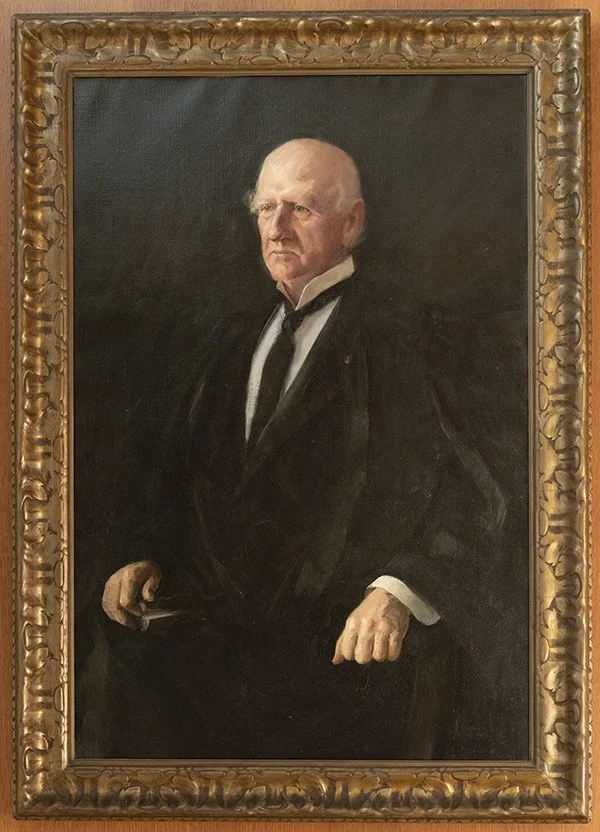
"I Allude to the Chinese Race"
Justice John Marshall Harlan's solo dissent in Plessy is, by wide agreement, one of the most celebrated passages in American constitutional law. "Our constitution is color-blind," he wrote, "and neither knows nor tolerates classes among citizens." Generations of civil rights lawyers, including the team that argued Brown, would invoke that line as the truer reading of the Fourteenth Amendment, the one the Court should have adopted in 1896 and finally did, in substance, fifty-eight years later.1
What rarely makes it into the textbook excerpt is the sentence Harlan used to make his point land. Arguing that Louisiana's segregation law made no sense even on its own terms, Harlan pointed to a group he considered more genuinely excluded from American life than the Black plaintiffs the law targeted: "There is a race so different from our own that we do not permit those belonging to it to become citizens of the United States. Persons belonging to it are, with few exceptions, absolutely excluded from our country. I allude to the Chinese race. But, by the statute in question, a Chinaman can ride in the same passenger coach with white citizens of the United States, while citizens of the black race in Louisiana... are yet declared to be criminals... if they ride in a public coach occupied by citizens of the white race."2 Harlan was referring to the legal regime built by the Chinese Exclusion Act and the federal naturalization bar this series has already traced through Chae Chan Ping and Ozawa, laws that barred most Chinese immigration outright and made naturalization effectively unavailable to those already here.
Harlan was not arguing for Chinese equality. He was using their categorical exclusion, a status he treated as sufficiently settled that he could treat it as an uncontroversial premise, as a baseline of acceptable discrimination against which Louisiana's treatment of Black citizens should look even more absurd by comparison. The argument only works if the reader already agrees that excluding Chinese immigrants from citizenship entirely was reasonable. Harlan's commitment to equal citizenship extended to Black Americans but stopped well short of embracing racial equality as a universal principle; this series' own earlier pieces have already shown as much: he later joined the dissent in Wong Kim Ark, voting to deny birthright citizenship to a man born on American soil, on essentially the same theory that Chinese Americans existed permanently outside the category of person the Constitution was built to protect.3 The single most quoted sentence in American civil rights law was written by a man who, in the same breath, treated Asian exclusion as too settled a fact to need defending.
This is not a reason to discard Harlan's dissent, and Asian American legal advocates writing about this passage have generally said so directly. It is a reason to read it whole rather than in the version that gets excerpted in classrooms, the one that often omits the sentence about "the Chinese race" before reprinting the line about a colorblind Constitution.4The pattern has continued well past the textbooks. When the Supreme Court decided Students for Fair Admissions v. Harvard in 2023, a case this series has already covered in depth, justices across the ideological spectrum invoked Harlan's "our Constitution is color-blind" line as their authority, with barely any acknowledgment of the sentence about Chinese exclusion sitting right beside it, even though the plaintiffs whose grievance the case turned on were themselves Asian American.5 The foundation this series keeps returning to, the doctrinal floor under nearly every case it has covered, was built, even in its most celebrated dissent, with at least one community already written out of the room, and the room hasn't fully reckoned with that fact even now.
What "Separate but Equal" Actually Built
The majority opinion in Plessy, far less quoted than Harlan's dissent but far more consequential for decades afterward, held that Louisiana's railcar law didn't violate the Fourteenth Amendment as long as the separate accommodations were roughly equal. Because Plessy's case challenged segregation itself rather than the quality of the accommodations provided, the Court accepted Louisiana's assertion that the cars were equal without closely examining whether they actually were, a standard later cases would sometimes scrutinize more seriously, but one that in practice was rarely enforced with any rigor.6 That holding became a central doctrinal foundation for segregation statutes passed across the South over the next several decades, and it traveled further than railcars. Thirty-one years later, Mississippi cited Plessydirectly to justify excluding nine-year-old Martha Lum from her white school on the grounds that the state's "separate but equal" framework extended just as easily to a Chinese American child as to a Black one.7 Gong Lum v. Rice did not need to invent a new doctrine to keep Martha Lum out. Plessy had already built the doctrine. Mississippi only had to argue it applied to a category Louisiana's law had never contemplated.
That is the pattern worth naming plainly: a foundation built around one specific exclusion rarely stays contained to it. Once the Court held that the Constitution tolerated separation as long as separate things were nominally equal, the principle was available to anyone who wanted to draw a new line, against a new group, using the same justification. Homer Plessy lost his case, paid a twenty-five dollar fine, and lived the rest of his life in relative obscurity; the Comité des Citoyens that had organized his test case disbanded shortly after. In January 2022, more than a century later, Louisiana's governor formally pardoned him, the first pardon issued under a state law specifically built for convictions secured under discriminatory statutes.8 The pardon corrected Plessy's own record. It did nothing, and could do nothing, to undo what the doctrine his case produced had already done to people who were never named in it at all.
A Brief Filed for Someone Else's Children
Brown v. Board of Education finally struck down the doctrine Plessy had built, holding that segregated schools were inherently unequal regardless of how comparable the physical facilities might be made.9 Brown's most direct doctrinal predecessors were a line of NAACP-led graduate school cases, Missouri ex rel. Gaines v. Canada (1938), Sipuel v. Board of Regents (1948), Sweatt v. Painter and McLaurin v. Oklahoma (both 1950), each chipping away at "separate but equal" by demonstrating concretely how unequal segregated graduate education actually was. One important and often-overlooked precursor sits alongside that line rather than ahead of it: in Mendez v. Westminster (1947), Mexican American families in Orange County, California, successfully challenged the segregation of their children into separate "Mexican schools," and the Japanese American Citizens League filed an amicus brief in that case alongside the NAACP and the American Jewish Congress, with Thurgood Marshall co-authoring the NAACP's submission years before he would argue Brown itself.10 Marshall carried arguments refined in Mendez, together with the NAACP's longer campaign running through the graduate school cases, into the legal strategy that ultimately won in Brown.
The connective tissue runs in more than one direction. Some scholars examining Brown's reasoning, notably Drew S. Days III, have argued that Chief Justice Warren's opinion leaned on social-science evidence about the psychological harm of segregation, evidence that later became the subject of substantial scholarly criticism, when language the Court itself had already articulated was sitting in this series' own first wartime piece: Hirabayashi v. United States had stated, in 1943, that "distinctions between citizens solely because of their ancestry are by their very nature odious to a free people whose institutions are founded upon the doctrine of equality."11 This remains a minority view among constitutional historians, not a settled account of how Brown could or should have been decided, and it carries its own irony worth naming directly: Hirabayashi itself, this series has already shown, went on to uphold the curfew it was reviewing, applying exactly the kind of ancestry-based distinction its own language condemned. The principle outlived the case that stated it and proved, in the hands of later scholars looking back, more durable than the result the Court actually reached in 1943.
Two Doctrines, Read Against Each Other
Read together, Plessy and Brown describe the same arc this series has traced inside individual Asian American cases, just at a larger scale and with a different community formally at the center each time. Plessy built a doctrine flexible enough to reach almost anyone a state wanted to exclude, using language that, even in dissent, treated one community's exclusion as too obvious to argue about. Brown dismantled that doctrine on the strength of a decades-long NAACP litigation campaign that Asian American organizations contributed to at points along the way, for someone else's children, years before the case that gets the credit. Neither case "belongs" to Asian American history in the way the other twelve pieces in this series do. Both cases shaped it anyway, the way a foundation shapes a structure that's mostly invisible once the building is finished. You don't see the foundation in the photographs. You'd find it the moment anything above it started to crack.
Related Cases and Precedents
The Plaintiff Without a Name (Students for Fair Admissions v. Harvard, 2023) — This series' earlier piece on the case that ended race-conscious admissions; this piece adds a detail worth sitting with: the justices on every side of that decision invoked Harlan's Plessy dissent, while the same dissent's language about Chinese exclusion went almost entirely unmentioned, even with Asian American plaintiffs at the case's center.
Gong Lum v. Rice (1927) — This series' earlier piece traced exactly how Plessy's doctrine extended to a Chinese American child a generation after Homer Plessy's own case; this piece supplies the foundation that extension rested on.
United States v. Wong Kim Ark (1898) — Justice Harlan's vote in dissent here, two years after his celebrated Plessy dissent, shows the same justice applying his "exclusion is settled" assumption about Chinese Americans in a different case entirely.
Lau v. Nichols (1974) / Guey Heung Lee v. Johnson (1971) — Both pieces in this series unfold directly inside the desegregation framework Brown made possible, with Chinese American families on opposite sides of what that framework actually delivered.
Loving v. Virginia (1967) — This series' companion piece on Naim v. Naim traces how Brown's own fragility, in its first year, shaped the Court's deliberate avoidance of a related civil rights question for over a decade.
Mendez v. Westminster (1947) — A precursor running alongside the NAACP's longer graduate-school litigation campaign (Gaines, Sipuel, Sweatt, McLaurin), built by Mexican American families with direct institutional support from the Japanese American Citizens League.
Sources and Further Reading
For deeper reading:
Gabriel J. Chin, "The Plessy Myth: Justice Harlan and the Chinese Cases," 82 Iowa Law Review 151 (1996)
"The Incoherence of the 'Colorblind Constitution,'" California Law Review (2025), on Harlan's dissent and its selective invocation in Students for Fair Admissions
Keith Weldon Medley, We As Freemen: Plessy v. Ferguson (Pelican Publishing, 2003)
Richard Kluger, Simple Justice: The History of Brown v. Board of Education and Black America's Struggle for Equality (Knopf, 1976)
IDRA's resources on Mendez v. Westminster and its relationship to Brown v. Board of Education
Footnotes
Plessy v. Ferguson, 163 U.S. 537, 559 (1896) (Harlan, J., dissenting). ↩
Id. at 561; Gabriel J. Chin, "The Plessy Myth: Justice Harlan and the Chinese Cases," 82 Iowa Law Review 151 (1996). ↩
Chin, supra note 2; United States v. Wong Kim Ark, 169 U.S. 649 (1898) (Fuller, C.J., and Harlan, J., dissenting). ↩
Advancement Project, "Asian American Belonging: Caste and Constitutionality in the U.S."; Law & Liberty, "A Race So Different from Our Own." ↩
Anonymous student note, "The Incoherence of the 'Colorblind Constitution,'" California Law Review (2025), documenting how Chief Justice Roberts, Justice Thomas, and dissenting justices all invoked Harlan's "color-blind" line in Students for Fair Admissions v. Harvard, 600 U.S. 181 (2023), without engaging the same dissent's language on Chinese exclusion. ↩
Plessy v. Ferguson, 163 U.S. 537 (1896). ↩
Gong Lum v. Rice, 275 U.S. 78 (1927). ↩
BlackPast.org, "(1896) The Plessy v. Ferguson Decision," noting the $25 fine and Homer Plessy's 2022 posthumous pardon under Louisiana's Avery Alexander Act; Keith Weldon Medley, We As Freemen: Plessy v. Ferguson (Pelican Publishing, 2003). ↩
Brown v. Board of Education, 347 U.S. 483 (1954). ↩
IDRA, "Méndez Ruling Declaring School Segregation Unconstitutional Led the Way to Brown v. Board of Education." ↩
Drew S. Days III, "Brown Blues: Rethinking the Integrative Ideal," 34 William & Mary Law Review 53 (1992); Hirabayashi v. United States, 320 U.S. 81, 100 (1943) ("Distinctions between citizens solely because of their ancestry are by their very nature odious to a free people whose institutions are founded upon the doctrine of equality."), quoted directly in subsequent scholarship including Eric S. Fish, "Korematsu, Hirabayashi, and the Second Monster," Texas Law Review (2020), and Jessica A. Clarke, Virginia Law Review (2023). ↩