
The Case the Court Wouldn't Touch
Naim v. Naim (1955–56) · Loving v. Virginia (1967)
This piece does something different from everything else in this series. Loving v. Virginia is not an Asian American case. Richard Loving was white. Mildred Loving was Black. The law they fought was built, like most of the South's anti-miscegenation statutes, around a Black-white racial line that had nothing to do with anyone in this series, directly. But running straight through the middle of Loving's actual history is a case almost nobody remembers, a Chinese sailor whose marriage the Supreme Court could have ended this fight over a decade earlier and chose, twice, not to. That refusal, and what it cost, belongs in this series anyway, because it shows something the other twelve cases couldn't: what happens when the Court has the chance to rule and decides the moment is too inconvenient.
A Marriage, Annulled Twice, by Two Different Courts
In 1952, a Chinese sailor named Han Say Naim married Ruby Elaine Naim, a white woman, in North Carolina, where such a marriage was legal, unlike in Virginia, where North Carolina's own anti-miscegenation law banned marriages between white and Black residents but said nothing about marriages between white and Asian ones.1 Virginia, where the couple actually lived, had no such gap. Its 1924 Racial Integrity Act voided any marriage between a "white person" and anyone who wasn't, defining white so narrowly that it required "no trace whatsoever of any blood other than Caucasian." The Naims returned to Virginia and lived as husband and wife for a year. Then Ruby filed for an annulment, citing the very law her own marriage had been built to dodge.
A Virginia circuit judge granted it. Han Say Naim's attorney, David Carliner, argued the law violated due process and equal protection, the same arguments that would eventually win in Loving, twelve years later. The Virginia Supreme Court of Appeals rejected the argument and upheld the annulment, leaning on a string of precedent that included Pace v. Alabama (1883) and dicta from Plessy v. Ferguson itself.2 Carliner appealed to the U.S. Supreme Court, and what happened next is the part of this story that should unsettle anyone who assumes the Court simply applies the law as it finds it.
"One Bombshell at a Time Is Enough"
The case reached the Court through a mandatory appeal rather than the modern certiorari process, meaning the justices couldn't simply decline to take it the way they often can today. Avoiding a decision on the merits required real procedural maneuvering instead. Justice Felix Frankfurter argued privately that deciding Naim on the merits risked "seriously embarrass[ing] the carrying-out of the Court's decree" in Brown v. Board of Education, decided the year before, a concern made sharper by the fact that the Court was simultaneously working through the controversial "all deliberate speed" language of Brown II, handed down only months earlier. Justice Tom Clark, persuaded, drafted an opinion claiming the case record was too unclear to address "in clean-cut and concrete form," and the Court, in November 1955, vacated the Virginia court's ruling and sent the case back, ostensibly so the record could be clarified.3Chief Justice Earl Warren had reportedly drafted his own dissent from this maneuver and abandoned it; the legal scholar Christopher Leslie recounts that Warren later privately characterized the Court's handling of the case as "total bullshit."4
Virginia's Supreme Court of Appeals did not take the hint. In January 1956, it declined to reopen the record, noting that nothing in Virginia procedure even allowed it to do what the U.S. Supreme Court had asked, and reaffirmed its original decision exactly as written.5 Carliner brought the case back to Washington a second time, asking the Court to either fix its own mandate or finally hear the case on the merits. The Court, rather than confronting Virginia's refusal to comply directly, dismissed the appeal entirely, ruling that the Virginia court's second decision "leaves the case devoid of a properly presented federal question," an outcome many legal historians have characterized as a transparently manufactured procedural exit from a dispute the Court had, by its own justices' private correspondence and later recollections, simply decided it didn't want to touch yet.6 Justice Tom Clark is reported to have explained the reasoning in plainer terms than anything that made it into the opinion itself: "one bombshell at a time is enough."
Han Say Naim's marriage stayed annulled. The constitutional question his case raised, the same question Loving would answer eleven years later, went unanswered, not because the Court found a good legal reason to leave it alone, but because, as Frankfurter's correspondence and Clark's later recollections strongly suggest, the country had just absorbed Brown and the justices were not willing to risk a second fight that large at the same time.
A Man Who Had Already Lost Everything Once
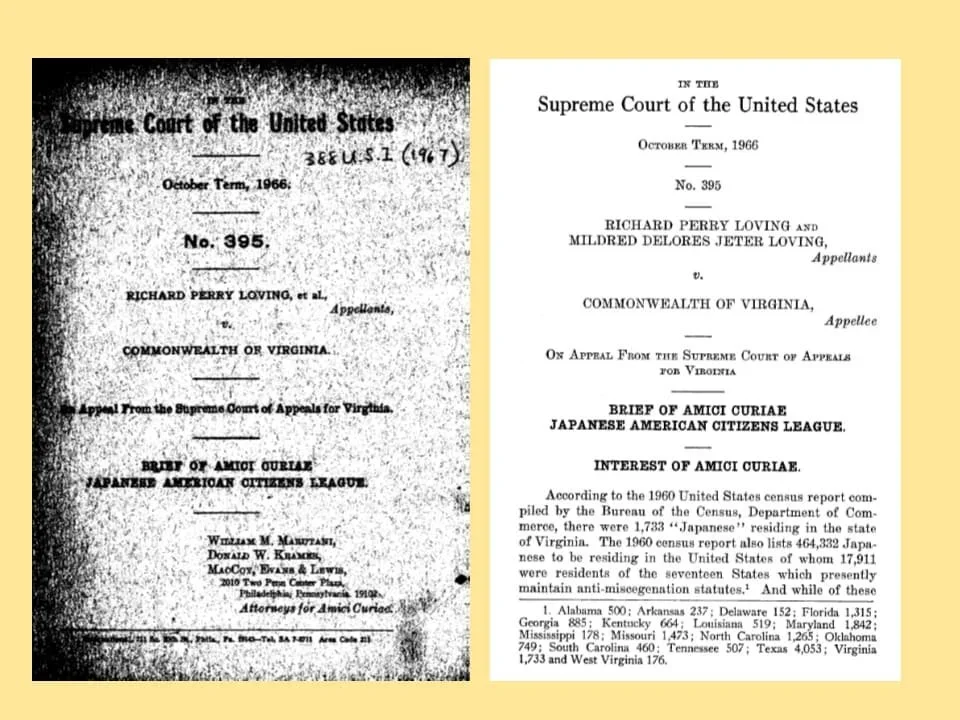
When Loving finally reached oral argument in 1967, the Japanese American Citizens League was the only amicus granted time to argue before the Court, the only outside voice the justices allowed into the room alongside the parties themselves.7 The man who stood up to make that argument was William Marutani, a Nisei attorney from Philadelphia who had been forcibly removed from his home on the West Coast as a young man and incarcerated, along with his family, first at the Pinedale Assembly Center and then at Tule Lake, two of the same camps this series has already documented at length in its account of Hirabayashi, Yasui, Korematsu, and Ex parte Endo.8 He had tried to enlist after his release and was rejected because of his ancestry, then drafted anyway and sent to Japan as a counterintelligence officer once the Army decided it needed Japanese-speaking soldiers more than it cared about excluding them.
Marutani told the Court directly that Virginia's law required proving "no trace whatever of any blood other than Caucasian," a standard he argued no human being could actually satisfy. He went further, arguing that clerks, judges, and juries were left to take "vague and scandalous terms such as colored person, white person, Caucasian" and apply their own interpretation of them, and that the whole apparatus rested on exactly that kind of arbitrary, unreviewable discretion.9 The brief mattered for a specific reason beyond the rhetoric: it pressed the Court to see Virginia's statute not merely as a Black-white law that happened to exist, but as part of a broader racial classification system that reached other communities too, Marutani's own included, regardless of how few Japanese Americans actually lived in Virginia at the time. Virginia's attorney, defending the statute, dismissed the relevance of Marutani's own community directly, telling the Court that Japanese Americans made up less than a quarter of one percent of Virginia's population and didn't "present the probability of sufficient interracial marriages" to matter. Chief Justice Warren pushed back immediately: did that mean Virginia could deny equal protection to anyone simply because there weren't many of them. Virginia's attorney never really answered.10
Marutani was asked, almost as an aside, whether Japan itself prohibited interracial marriage. He said he didn't know, and added that his own mother might have objected to him marrying a white woman, as a matter of custom, but that custom wasn't the state's business to enforce.11 It is a small moment in a long transcript, and it says something true about the case anyway: the man arguing against Virginia's law had personally survived the same government deciding, by ancestry alone, that he didn't belong, and he was now standing in front of that government's highest court explaining, calmly, why it had no business making that decision for anyone else either.
What the Delay Actually Cost
The Supreme Court ruled unanimously in Loving, striking down Virginia's law and, with it, every remaining anti-miscegenation statute in the country. The opinion also explicitly rejected the "equal application" reasoning from Pace v. Alabama that had insulated bans like Virginia's for decades, the idea that a law punishing both parties to an interracial relationship equally couldn't be racially discriminatory; the Court held that this logic, too, had no place in equal protection analysis.12 Chief Justice Warren's opinion didn't need Marutani's argument to win; the Due Process and Equal Protection grounds Carliner had already raised in Naim, more than a decade earlier, carried the day on their own. But the eleven years between Naim's dismissal and Loving's decision were not empty years. Many historians have argued the delay was consequential rather than merely procedural: David B. Cruz and others studying the gap have suggested that by 1967, interracial marriage bans had already become a minority position even within the South, while a ruling closer to 1955, before the backlash against Brown had fully crystallized, might have landed differently, for reasons that remain debated rather than settled.13 What's less debatable is the cost to the one person whose case actually tested the question first: the Court's caution in 1955 meant Han Say Naim's marriage stayed dissolved for the rest of his life, and many couples in the sixteen states that still enforced anti-miscegenation laws through the 1950s and 1960s remained unable to marry or stay married under statutes several justices had privately appeared to doubt could survive constitutional scrutiny.
This is the throughline that connects a case with no Asian American party at its center to a series built around exactly that kind of case. The Court's caution in Naim wasn't really about Han Say Naim specifically; he simply happened to be the person whose case tested the question first, the way Lem Moon Sing and Sing Tuck and Ju Toy happened to test the limits of habeas access first, not by choice, but because history placed them at the point where a longstanding constitutional question finally reached the Court. And the actual undoing of the law that destroyed his marriage came, a decade later, partly through the advocacy of a man who had personally survived the same machinery of exclusion this series has spent several pieces describing, standing in the same courtroom, making an argument the Court could have heard in 1955 and chose not to.
Related Cases and Precedents
Brown v. Board of Education (1954) — The decision Frankfurter feared Naim would jeopardize; the Court's caution in Naim was a direct, acknowledged consequence of Brown's own fragility in its first year.
Plessy v. Ferguson (1896) / Pace v. Alabama (1883) — The doctrinal precedent Virginia's courts leaned on to uphold the Naims' annulment, the same lineage this series has already traced through Gong Lum v. Rice.
Loyalty on Trial (Hirabayashi, Yasui, Korematsu, Ex parte Endo) — William Marutani's own incarceration at Pinedale and Tule Lake places him directly inside the history this series' wartime piece covers; he later served on the federal commission that led to redress under the Civil Liberties Act of 1988.
Perez v. Sharp (1948) — The California Supreme Court's earlier ruling striking down that state's ban on white-Asian marriage specifically, the first court in the country to invalidate an anti-miscegenation law, two decades before Loving reached the same conclusion nationally.
Sources and Further Reading
For deeper reading:
Peter Wallenstein, Tell the Court I Love My Wife: Race, Marriage, and Law—An American History (St. Martin's Press, 2002)
Peggy Pascoe, What Comes Naturally: Miscegenation Law and the Making of Race in America (Oxford University Press, 2009)
Stephen Chahn Lee's writing on William Marutani and the JACL's role in Loving v. Virginia at stephenleelaw.com
Densho Encyclopedia's entry on William Marutani, including his later service on the Commission on Wartime Relocation and Internment of Civilians
Footnotes
Naim v. Naim, 197 Va. 80, 87 S.E.2d 749 (1955); Wikipedia, "Naim v. Naim." ↩
Naim v. Naim, 197 Va. 80 (1955), opinion text via Encyclopedia Virginia. ↩
Michael Dorr, "Principled Expediency: Eugenics, Naim v. Naim, and the Supreme Court," 42 American Journal of Legal History 119 (1998); uscivilliberties.org, "Naim v. Naim." ↩
Christopher R. Leslie, "Justice Alito's Dissent in Loving v. Virginia," Boston College Law Review, quoting Chief Justice Warren's characterization of the Court's handling of Naim. ↩
Naim v. Naim, 197 Va. 734, 90 S.E.2d 849 (1956), via CourtListener. ↩
Naim v. Naim, 350 U.S. 985 (1956); Dorr, supra note 3, characterizing the dismissal as a deliberate avoidance widely discussed in the legal-historical literature; HuffPost, "What's in a Naim?", recounting Justice Tom Clark's reported recollection. ↩
Loving v. Virginia, 388 U.S. 1 (1967), counsel listing via Library of Congress. ↩
Densho Encyclopedia, "William Marutani." ↩
Loving Day, "Supreme Court Arguments." ↩
Encyclopedia Virginia, "Excerpts from a Transcript of Oral Arguments in Loving v. Virginia (April 10, 1967)."↩
Stephen Chahn Lee, "Loving v. Virginia: The JACL Argues for Interracial Marriage," stephenleelaw.com. ↩
Loving v. Virginia, 388 U.S. 1 (1967). ↩
David B. Cruz, commentary on Naim v. Naim, uscivilliberties.org, supra note 6, on the jurisprudential and political differences between the mid-1950s and 1967. ↩