
The Land in His Son's Name
Oyama v. California (1948)
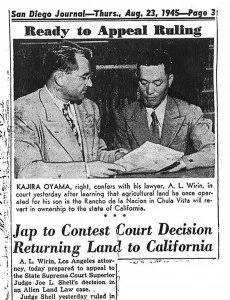
Kajiro Oyama came to the United States in 1914 at fifteen, hoping eventually to study at the California Institute of Technology. He became a farmer instead, the same path nearly every Japanese immigrant in California found waiting for them regardless of what they'd actually hoped to do with their lives, because California's law had already decided, years before he arrived, what a man like him would be allowed to own.
A Law Built to Make Ownership Impossible
California's Alien Land Law, passed in 1913 and tightened further by a 1920 ballot initiative, barred any "alien ineligible for citizenship" from owning agricultural land.1 The law never named Japanese immigrants directly. It didn't need to. Federal naturalization law already made every Japanese immigrant in the country racially ineligible for citizenship, a category this series has already traced through Ozawa v. United States, so a law restricting land ownership to citizens and "eligible aliens" reached exactly the people California's legislature wanted it to reach, without ever writing their nationality into the statute itself. The U.S. Supreme Court upheld the 1920 version of the law against constitutional challenge in 1923, in Porterfield v. Webb, decided the same year as two companion cases testing the same law from different angles; the Court found nothing arbitrary in California's choice to bar ineligible aliens from agricultural land, and that holding stood as settled law for the next twenty-five years.2
Japanese immigrant farmers, like immigrant farmers facing similar laws in other Western states, often found a narrow, technically legal way through. If a man's American-born child held the title, and the child was a citizen by birth the same way every plaintiff this series has met since Wong Kim Ark was, the land could be purchased and kept in the family, with the father serving as the child's guardian rather than the land's owner of record. It was not a secret workaround. The 1920 law required guardians of land held this way to file annual reports with the Superior Court identifying the minor in whose name the land had been transferred, a layer of state scrutiny built directly into the statute that made these arrangements easy to revisit and attack years later if the paperwork ever lapsed.3
Kajiro Oyama did exactly this, carefully and on the record. In 1934, he purchased six acres of agricultural land in Chula Vista, near San Diego, paying $4,000 of his own money, and had the deed executed directly to his son Fred, then six years old. He petitioned the local Superior Court to be named Fred's legal guardian and disclosed plainly that Fred owned the land. In 1937, he bought two more adjacent acres the same way. He filed guardian's reports, planted the parcels with lemon trees and, later, the tomatoes and peppers and celery that would become the family's livelihood. None of this was hidden. All of it was exactly the arrangement the statute's own text contemplated, and the same arrangement Porterfield had already confirmed California had the power to police closely.
What Happened While They Were Forbidden to Come Home
In 1942, the Oyama family was forced from their home along with every other person of Japanese ancestry on the West Coast, swept into the same machinery this series has already documented at length in Hirabayashi, Yasui, Korematsu, and Ex parte Endo. The family ended up in Utah, outside the exclusion zone, where Fred later remembered the local Mormon community treating them with real kindness, and a seed salesman who happened to mention a farm near Cedar City they could move to, the kind of small, decent human gesture that rarely makes it into a Supreme Court record but is exactly the texture this series has tried to preserve wherever it survives.4 Fred finished high school in Payson, Utah, and went to work at a defense plant in Chicago before the war ended.
While the family was still forbidden to return to California, in 1944, the state attorney general's office filed a petition to escheat both parcels of land to the state, on the theory that the original 1934 and 1937 transfers had been fraudulent attempts to evade the Alien Land Law all along, made retroactively suspect by the simple fact that Kajiro had not filed every annual guardian's report on time, a lapse that coincided exactly with the years the family was barred by federal order from returning to the property at all.5 Enforcement of the Alien Land Law had varied across counties and slowed in the years just before the war; the Oyama prosecution arrived as part of a broader wave of renewed enforcement once wartime relocation had already left affected families unable to attend to their own paperwork in person, a timing that California's own attorney general's office did not deny.
A Test Case the Community Built on Purpose
The Oyamas did not fight this alone, and the way they organized their defense belongs in the same lineage this series has traced from the Chinese Six Companies funding Yick Wo's case through the JACL's later, complicated role in the wartime cases. Community leaders Keisaburo Koda and Shichinosuke Asano helped organize the Society for the Promotion of Japanese American Civil Rights specifically to fund a test case against the Alien Land Law, and the Oyamas' situation, methodical, well-documented, and squarely on point, became that case.6 A. L. Wirin, the ACLU's Southern California counsel, took it on, working alongside Hugh Macbeth, an African American attorney who had already supported the JACL's amicus efforts in Hirabayashi and Korematsu, and later James Purcell, the same attorney who had argued Ex parte Endo and won the narrowest victory in this entire series.7 The throughline connecting these wartime cases to this one was not abstract. It ran through the same small number of lawyers willing to take them on.
The case was lost twice before it ever reached Washington. The trial court found Kajiro had enjoyed the practical benefit of land technically owned by his son and ruled the transfers a subterfuge; California's Supreme Court affirmed, holding that the state's power to bar ineligible aliens from owning land extended to barring exactly this kind of guardianship arrangement, and that Fred himself had suffered no constitutional injury since the land, in the court's view, had never truly vested in him at all.8 Dean Acheson, soon to become President Truman's Secretary of State, argued the case before the U.S. Supreme Court alongside Wirin, a detail that says something about how far this fight had traveled from a Chula Vista farm by the time it reached the country's highest court.
The Court Ruled for the Son, Not the Father
On January 19, 1948, the Supreme Court reversed, 6 to 3, but the precise shape of the ruling matters as much as the outcome. Chief Justice Fred Vinson, writing for the majority, found that the law's discriminatory presumption violated Fred Oyama's rights: the state had treated the 1934 and 1937 transfers as evidence of fraudulent intent solely because Fred's father happened to be Japanese, a burden the law placed on no other citizen child receiving the same kind of gift from a citizen or eligible-alien parent.9 Having decided the case on that ground, the Court explicitly declined to reach the broader question of whether the Alien Land Law itself, as applied to Kajiro directly, violated his own rights, or whether the law could survive scrutiny at all. The ruling protected Fred, the citizen son, without ever ruling on whether his father, the man who had actually built the farm, raised the family, and spent two decades trying to make a life inside a law that functioned, in practice, to make exactly that difficult, had any rights the state was bound to respect.
Justice Robert Jackson, who had dissented four years earlier in Korematsu, dissented again here, but from the opposite direction: if the Court had already upheld California's basic power to exclude ineligible aliens from owning land, he argued, it couldn't logically object to the state enforcing that same power against a transparent workaround.10 His dissent is a useful reminder that this entire case sat on a strange doctrinal foundation. The Alien Land Law itself was never struck down. The Court simply found one specific application of it, against one specific citizen, intolerable, and left the rest of the structure standing.
That structure had real teeth behind it, the same teeth this series first noticed in Korematsu four years earlier. Korematsuis generally treated as the origin point of what would later become strict scrutiny doctrine, articulating language about subjecting racial classifications to "the most rigid scrutiny," though in its original form that language functioned more as justification for the government's action than as a real constraint on it, an irony this series has already sat with directly: the language meant to protect against racial discrimination was first used in a case that upheld it. Oyamaapplied a more searching version of equal protection review than the Court had previously brought to land law cases, and did so, notably, to strike something down rather than wave it through.11 The same doctrinal language that had done so little protective work in Korematsu went on, in cases like this one, to start doing real work, and from there it became part of the broader evolution in equal protection law that, within a few years, helped enable Brown v. Board of Education.12
What the Win Actually Settled
Kajiro Oyama did not get his own rights vindicated. The Court's ruling rested entirely on Fred's citizenship, not his father's decades of labor or his father's own claim to fair treatment under a law that had never made any secret of what it was built to do. The Alien Land Law itself remained on the books, struck down only piecemeal afterward, first by California's own Supreme Court in 1952, in a case that leaned directly on the reasoning Oyama had supplied, and only formally repealed by California voters in 1956, eight years after the Oyama family's own fight had ended.13
What the family actually got back was a farm, and the chance to keep building the life Kajiro had been trying to build since before Fred was born. What the case itself actually did, stripped of its outcome, was narrower and more particular than it might sound: it let courts treat a racial presumption embedded in property law as something requiring real justification, without going so far as to invalidate the broader alien land regime that presumption served. A. L. Wirin, looking back on his own career decades later, offered his own retrospective judgment that the Oyama case was one of the two most important he ever argued, "because they were able to establish principles which were the forerunners of the U.S. Supreme Court cases involving... the rights to equal treatment and equal protection under the law."14 That was Wirin's own assessment, not the Court's, but he wasn't speaking abstractly. He had watched the same legal reasoning his clients fought to establish, applied first against an entirely different community in the worst possible circumstances, become, within a decade, part of the broader doctrinal current that helped end segregated schooling for that other community entirely.
The Same Year, a Different Property Fight
Wirin's instinct that Oyama had become "forerunners" of later equal protection cases wasn't a retrospective stretch. It happened almost immediately, in the same property-law context Oyama had just fought through. Shelley v. Kraemer, decided that same year, 1948, struck down racially restrictive housing covenants nationwide, the private agreements neighborhoods used to bar specific groups from buying or occupying homes.15 The covenant at the center of the lead case, signed by St. Louis property owners in 1911, barred occupancy by anyone "of the Negro or Mongolian Race," language that wrote Asian Americans directly into the same exclusionary instrument the case struck down, not as an afterthought but as one of its two named targets from the start.
Justice Vinson's opinion for the Court, the same chief justice who had written Oyama a few months earlier, cited Oyama directly, in the same paragraph where the Court rejected the argument that a state's "police power" could justify denying equal enjoyment of property rights to a group defined by race.16 The two cases were doing related but distinct work: Oyama addressed a state statute directly barring ownership by a racially defined category of person; Shelleyaddressed private agreements enforced through the state's own courts, a different mechanism for reaching the same result. Read together, they describe a single year in which the Court found two separate doors, one legislative, one judicial, that states and private citizens had both been using to keep specific racial groups, including the one this series has spent the most time with, out of property ownership entirely.
It is also worth being honest about what Shelley did not do, the same caution this series brought to Oyama itself. The covenant could still exist on paper. Neighbors could still privately agree never to sell to a Black or Asian family. Only judicial enforcement of that agreement, the Court held, crossed into unconstitutional state action. The Federal Housing Administration announced within weeks that the ruling would not affect its own underwriting practices, and racially restrictive covenant language continued to sit in property deeds across the country for decades after Shelley, unenforceable but unremoved, until the Fair Housing Act of 1968 finally targeted the private conduct itself rather than only the judicial enforcement of it.17 Oyama and Shelley both won real, important ground in the same year. Neither one, on its own, finished the job either was actually fighting.
The deposition record left behind one final, quiet detail worth sitting with, the kind this series keeps finding in case after case. A neighbor testifying as a witness for the state was asked whether he knew Kajiro Oyama. He said he'd never heard the name. Asked if he knew Fred Oyama, he said yes, of course, that was the only way he knew the family at all: by the son's name, not the father's. The man who had built the farm, fought to keep it through two decades of a law designed to take it from him, and spent years in Utah waiting to come home to it, was, to the very witnesses called to testify about his own land, simply Fred's father.
Related Cases and Precedents
Takao Ozawa v. United States (1922) — Established the racial ineligibility for naturalization that made Kajiro Oyama, and every Japanese immigrant of his generation, legally "ineligible" under the Alien Land Law in the first place.
Porterfield v. Webb (1923) — Upheld California's 1920 Alien Land Law against constitutional challenge twenty-five years before Oyama, settling the basic question this case would only partially revisit.
United States v. Wong Kim Ark (1898) — The birthright citizenship principle that made Fred Oyama a citizen by birth, the legal fact the entire case ultimately turned on.
Korematsu v. United States (1944) / Ex parte Endo (1944) — The wartime exclusion that displaced the Oyama family is the same machinery this series traced at length; Oyama's own legal team included James Purcell, Endo's attorney, and built on the strict scrutiny standard Korematsu first applied.
Sei Fujii v. California (1952) — The California Supreme Court decision that finally struck down the Alien Land Law as unconstitutional, relying directly on the reasoning Oyama had established four years earlier.
Brown v. Board of Education (1954) — The strict scrutiny standard this case helped develop into a tool of protection, rather than deference, would go on to anchor the doctrinal reasoning behind ending school segregation six years later.
Sources and Further Reading
For deeper reading:
Rose Cuison Villazor, "Rediscovering Oyama v. California: At the Intersection of Property, Race, and Citizenship," 87 Washington University Law Review 979 (2010)
Greg Robinson, After Camp: Portraits in Midcentury Japanese American Life and Politics (University of California Press, 2012)
Frank F. Chuman, The Bamboo People: The Law and Japanese-Americans (Publisher's Inc., 1976)
Footnotes
Oyama v. California, 332 U.S. 633 (1948), statement of facts via Cornell Legal Information Institute. ↩
Porterfield v. Webb, 263 U.S. 225 (1923); see also Terrace v. Thompson, 263 U.S. 197 (1923), and Webb v. O'Brien, 263 U.S. 313 (1923), decided the same term and testing the same California and Washington alien land laws from different angles. ↩
Online Archive of California, "California Superior Court (Sacramento County) Alien Land Law Case Files, 1920–1947," on the 1920 law's annual reporting requirement for guardians; Densho Encyclopedia, "Oyama v. California." ↩
Asian American Bar Association of New York, "This Land Is Our Land: Oyama v. California," trial reenactment script drawing on Fred Oyama's own recollections; this and other narrative and biographical details in this section are sourced to this reenactment script and should be read as drawing on family recollection and secondary compilation rather than the trial record itself. ↩
Densho Encyclopedia, supra note 2; Oyama v. California, 332 U.S. 633 (1948), statement of facts. ↩
Densho Encyclopedia, supra note 2. ↩
AABANY, supra note 3; Densho Encyclopedia, supra note 2, on James Purcell's involvement. ↩
Oyama v. California, 332 U.S. 633 (1948), summarizing the California Supreme Court's prior ruling. ↩
Oyama v. California, 332 U.S. 633 (1948). ↩
Id. (Jackson, J., dissenting). ↩
Rose Cuison Villazor, "Rediscovering Oyama v. California: At the Intersection of Property, Race, and Citizenship," 87 Washington University Law Review 979 (2010); Greg Robinson & Toni Robinson, "Korematsu and Beyond: Japanese Americans and the Origins of Strict Scrutiny," 68 Law and Contemporary Problems 29 (2005). ↩
Robinson & Robinson, supra note 10. ↩
ACLU of San Diego & Imperial Counties, "Oyama v. California."; Online Archive of California, supra note 2, on Sei Fujii v. California (1952) and the law's 1956 repeal. ↩
ACLU of San Diego & Imperial Counties, "History." ↩
Shelley v. Kraemer, 334 U.S. 1 (1948), opinion text via Cornell Legal Information Institute. ↩
Id., citing Oyama v. California, 332 U.S. 633 (1948), directly in the Court's equal protection analysis. ↩
Wikipedia, "Shelley v. Kraemer," on the FHA's response and the Fair Housing Act of 1968; LegalClarity, "What Was Shelley v. Kraemer and Why Does It Matter?" ↩