The Question I Wish I'd Answered Differently About Free Speech
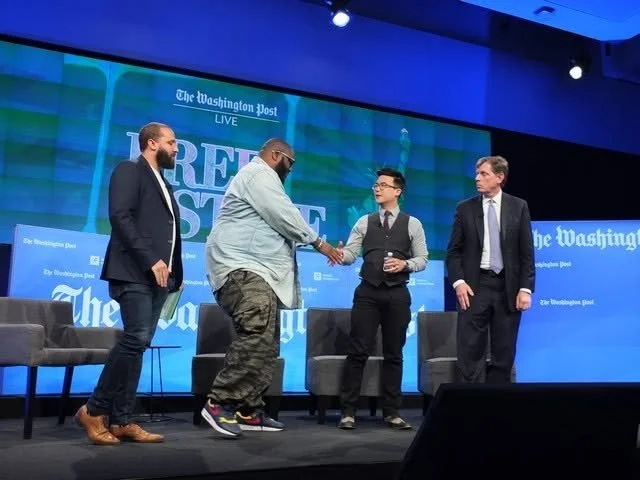
The Washington Post Live Free to State Summit (L-R): Wesley Lowery, Killer Mike, Simon Tam, and John Elwood.
In 2019, I appeared on a Washington Post Live panel with Killer Mike, journalist Wesley Lowery, and appellate litigator John Elwood, discussing rap lyrics being treated as evidence in criminal trials, The Slants' Supreme Court case, and the First Amendment. Looking back, I realize I answered an important question incorrectly…not because what I said was false, but because it wasn't complete.
At one point, Lowery turned to me and asked a version of a question I've been asked many times since: what should the government's role be in moderating art?
I gave an answer I still believe is true, as far as it goes. I talked about Matal v. Tam: how the Court rejected most of the government's arguments and ultimately ruled on First Amendment grounds, how I never thought our band name was disparaging in the first place, how the real issue was that it got treated differently specifically because of our racial identities. Then I pointed to something larger than my own case: that Black and brown artists don't get the same benefit of the doubt white artists do when they push boundaries. Sometimes, the people in power aren't even intending to suppress speech. They've just never lived inside the community whose art they're judging, so they don't connect with it the way someone who has would.
While true, I wish I would have said something different, because if anything, my understanding about justice and civil liberties has deepened since then.
I think about that moment from time to time because photos will sometimes pop up and the footage still lives out there, reminding me of what I said. Like everyone else in the world, I wish I could go back in time and make some edits.
The question wasn't really "how should the government adjudicate art." It was closer to: should the government be adjudicating art at all. And my answer in the room — useful, true, focused on disparate treatment — accepted the premise of the question before challenging it. I worked with the frame that I was offered instead of proposing a new frame altogether.
And it's true of most forms of expression, especially the five freedoms guaranteed by the First Amendment: press, religion, speech, assembly, and petition. It isn't about bad actors making the occasional bad call. It's that the government as a system isn't equipped to make these decisions at all, for reasons that have nothing to do with who happens to be in charge. Art relies on ambiguity to do its work; government rewards predictability and administrable rules. Bureaucracies are built to minimize risk to the institution, not to cultivate truth or push anyone toward an uncomfortable one.
None of this means all expression is consequence-free. Direct threats, incitement, harassment, and criminal conduct already occupy categories the law has long treated differently, with good reason. But those narrow exceptions prove the rule rather than undermine it: outside them, the state's role should be restraint, not cultural judgment.
What I'd say now: art is at its best when it's at its most honest, freely expressed without the artist calculating what the most powerful entity in the room will tolerate. The moment you introduce a government body as the arbiter of which expression is acceptable, you've already changed what the art is for. It stops being a search for truth, however uncomfortable, and starts being a negotiation with power. That's true regardless of whether the people doing the adjudicating are well-intentioned, fair-minded, and trying their best.
Equal censorship isn't justice. If the state lacks the competence and legitimacy to determine artistic value in the first place, applying that power evenly doesn't solve the problem. It merely distributes the injustice more fairly. The problem isn't bad actors making bad calls. It's that the position itself — government as art critic — is the wrong position for government to hold, no matter who's standing in it.
Winning Matal v. Tam taught me one lesson: governments are often bad at distinguishing between offense and harm. The years since taught me something deeper: they shouldn't be in the business of trying.
Killer Mike said something to the effect that we handle painful subjects the way a middle-class family avoids talking about its problems, instead of actually confronting them — and that confronting them honestly is the artist's job. Push the boundary. Say the uncomfortable thing. Make the room sit with it instead of looking away.
Rap on Trial cases are the most visible, highest-stakes version of what happens when that job collides with government power — prosecutors treating lyrics as literal confessions, a level of literal-mindedness that somehow never gets applied to a country song or a horror film about the same subject matter. But the underlying failure isn't really about who gets prosecuted. It's about a society deciding, case by case, whose discomfort is art and whose discomfort is a threat — and discovering, with depressing consistency, that the answer tracks who's speaking more than what's being said. None of this is really about justifying or condemning any single decision in isolation. It's about whether the system, taken as a whole, is fair. When we look at these cases one at a time, we start to treat the pattern as a series of exceptions rather than what it actually is: the norm a system produces when "mostly working" is treated as good enough.
I don't think my 2019 answer was wrong. I think it was incomplete: it diagnosed an inequity in how the rule gets applied, without questioning whether the rule should exist in that form at all. Disparate treatment is real, and I'll keep naming it. But fairness here isn't really about everyone getting equal access to government approval. It's about whether government approval should be a gate art has to pass through in the first place.
The best art has always made people in power uncomfortable. A system that asks artists to secure permission from the powerful before they're allowed to be uncomfortable has already defeated the purpose, no matter how evenly that permission gets distributed.
The point of free expression isn't that we'll always approve of what people create. It's that a free society trusts its people more than it trusts its institutions to decide what difficult truths are allowed to be spoken aloud.
I'm glad the footage exists anyway. Every so often, it's useful to see exactly where your own thinking has moved since.
I speak on First Amendment law, artistic freedom, and the role of government and institutions in regulating expression at law schools, universities, and civic organizations. If these questions connect to work you're doing, simontam.org/speaking is the place to start.